Type details
| Country | Biafra |
| Currency | Biafran pound |
| Denomination | 1 pound |
| Series | Republic of Biafra issue |
| Series range | 1968–1970 |
| Issue year | 1968 |
| Issuer | Bank of Biafra |
| Signatures | Governor: Jack W. Udoh; Director: [signature illegible] |
| Printer | Unknown |
| Reverse subject | National coat of arms of Biafra |
| Themes | indigenous_culture,commemorative |
| Watermark | Palm tree motif |
| Security features | microprint,intaglio,see_through_register |
| Colour palette | #8b7355,#d2b48c,#f5f5dc |
| Material | paper |
| Dimensions (mm) | 151x75 |
| Language / script | Latin |
| Languages | en |
| Pick # | P-5a |
| Rarity | scarce |
| Legal status | demonetized |
| Legal status date | 1970-01-15 |
| Predecessor currency | Nigerian pound |
| Successor currency | Nigerian naira |
| Era | 1946_1989 |
| Default value (low) | 30.0 |
| Default value (high) | 75.0 |
| Value currency | USD |
Front
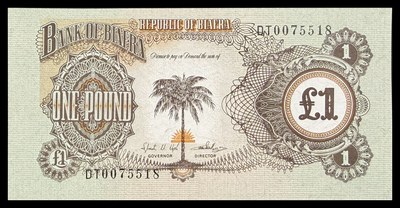
Palm tree rising from stylized sun, a central motif representing the tropical landscape and natural resources of Biafra. The palm tree was a key symbol of the short-lived Republic of Biafra (1967–1970), appearing on currency issued during the Nigerian Civil War to establish monetary independence from Nigeria. The note bears the promise 'Promise to pay on Demand the sum of ONE POUND' with signatures of the Governor and Director of the Bank of Biafra.
Back
The national coat of arms of the Republic of Biafra featuring an eagle surmounting a shield with a rising sun, flanked by two leopards, with the motto 'PEACE UNITY FREEDOM' on a banner below. This emblem was adopted by Biafra upon its declaration of independence from Nigeria in 1967, incorporating imagery meaningful to the Igbo people and other ethnic groups of the secessionist region. The coat of arms symbolized the aspirations of the breakaway state during its three-year existence.
History
The Republic of Biafra issued its own currency series beginning in 1968, after seceding from Nigeria in May 1967 under the leadership of Colonel Odumegwu Ojukwu. The Biafran pound was introduced to replace the Nigerian pound in the secessionist territory comprising the Eastern Region, primarily inhabited by the Igbo people. These notes circulated during the Nigerian Civil War (1967–1970) until Biafra's surrender in January 1970, after which they were demonetized. The Bank of Biafra operated as the monetary authority of the unrecognized state. Biafran currency is now a historical artifact commemorating a tragic conflict that claimed over one million lives, many from starvation during the blockade.
Linked specimens (1)
Merge into another type
Repoints every linked specimen above to the chosen target type, fills any target nulls from this type, then deletes this type. This cannot be undone.