Type details
| Country | Uruguay |
| Currency | Nuevo Peso |
| Denomination | 50 Nuevos Pesos / 5 Cents |
| Series | Series 481 |
| Issuer | Banco Central del Uruguay |
| Printer | Thomas De La Rue & Company, Limited |
| Reverse subject | Military Payment Certificate iconography |
| Themes | architecture |
| Security features | intaglio,microprint |
| Colour palette | #e6d9a8,#6b7a99,#2d3436 |
| Material | paper |
| Language / script | Latin |
| Languages | es,en |
Front
The Banco Central del Uruguay building in Montevideo, a neoclassical structure with prominent columned facade. The building serves as the headquarters of Uruguay's central bank, established in 1967. The architectural rendering shows the two-story structure with ground-floor colonnade and upper-level balconied windows, representative of early 20th-century institutional architecture in the capital.
Back
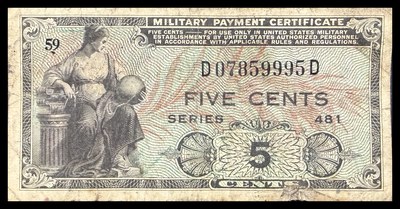
United States Military Payment Certificate (MPC) Series 481, denomination five cents. MPCs were special currency issued by the U.S. Department of Defense for use by military personnel in foreign countries, designed to prevent black market currency speculation and maintain separation between military and local economies. Series 481 was one of many MPC series issued during the Cold War era, intended for use only in U.S. military establishments by authorized personnel in accordance with applicable rules and regulations.
History
This note presents a highly unusual pairing: the front appears to be a Uruguayan 50 nuevos pesos note issued by the Banco Central del Uruguay (printed by Thomas De La Rue & Company, Limited as indicated), while the back is clearly a United States Military Payment Certificate (MPC) Series 481, five cents denomination. The Uruguayan nuevo peso was introduced in 1975, replacing the previous peso at 1000:1 during a period of severe inflation. MPCs were used by U.S. military forces from 1946 to 1973 in various overseas locations. The juxtaposition of these two completely unrelated monetary instruments—one a sovereign central bank note, the other a military scrip—is extraordinarily anomalous. This could represent: (1) a novelty/educational piece combining unrelated designs, (2) a proof or specimen pairing error, (3) a fantasy note, or (4) deliberately mismatched images. No known legitimate banknote combines a Uruguayan central bank obverse with a U.S. MPC reverse. The authenticity and provenance of this item are highly questionable as a circulating note.