Type details
| Country | Venezuela |
| Currency | VEB |
| Denomination | 10 Bolívares |
| Issue year | 1981 |
| Issuer | Banco Central de Venezuela |
| Signatures | Presidente: [illegible signature]; Primer Vice-Presidente: [illegible signature] |
| Printer | American Bank Note Company |
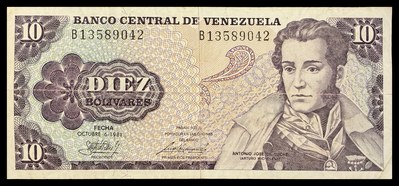
| Front portrait | Antonio José de Sucre |
| Reverse subject | Independence monument |
| Themes | statesman,military,commemorative,independence |
| Security features | intaglio,microprint |
| Colour palette | #5c4d6b,#f5e6d3,#1a1a1a |
| Material | paper |
| Language / script | Latin |
| Languages | es |
| Pick # | 60 |
| Rarity | common |
| Legal status | demonetized |
| Legal status date | 2008 |
| Successor currency | Bolívar Fuerte (VEF) |
| Era | 1946_1989 |
| Default value (low) | 2.0 |
| Default value (high) | 8.0 |
| Value currency | USD |
Front
Independence monument at center, depicting the Battle of Carabobo Monument in Valencia, Venezuela. This allegorical sculpture complex, unveiled in 1921, commemorates the decisive Battle of Carabobo (June 24, 1821) that secured Venezuelan independence from Spain. The monument features equestrian statues and allegorical figures representing liberty and the republic. At right, the coat of arms of Venezuela within an ornamental medallion, showing the national emblem adopted in 1836 featuring a white horse galloping left (representing independence and freedom), wheat sheaves, and flags.
Back
Antonio José de Sucre (1795–1830), Venezuelan independence leader, military strategist, and Grand Marshal of Ayacucho. Sucre was Simón Bolívar's most trusted general and served as the second President of Bolivia (1825–1828). He played a decisive role in the liberation of Ecuador, Peru, and Bolivia from Spanish rule, and his victory at the Battle of Ayacucho (1824) effectively ended Spanish colonial dominance in South America. He is revered as one of Latin America's greatest military heroes and appears on numerous Venezuelan banknotes.
History
This note belongs to the 1981 issue of Venezuelan bolívares printed by the American Bank Note Company, clearly indicated by the printer's imprint at the bottom of the front. The date 'OCTUBRE 16 DE 1981' is printed on the back, establishing the specific issue date. This series circulated during Venezuela's oil-boom era before the economic crises of the late 20th century. The Venezuelan bolívar (VEB) was eventually replaced by the bolívar fuerte (VEF) in 2008 at a rate of 1000:1 due to hyperinflation, making these older notes demonetized. The 10 bolívares denomination featured Antonio José de Sucre, one of the most honored figures of South American independence, and the Carabobo monument celebrating Venezuela's definitive independence victory.
Linked specimens (1)
Merge into another type
Repoints every linked specimen above to the chosen target type, fills any target nulls from this type, then deletes this type. This cannot be undone.