Type details
| Country | Yemen |
| Currency | Yemeni Rial |
| Denomination | 1 Rial |
| Issuer | Central Bank of Yemen |
| Issuer (native) | البنك المركزي اليمني |
| Themes | agriculture |
| Colour palette | #8b7355,#4a5d23,#d4c4b0 |
| Material | paper |
| Language / script | Arabic, Latin |
| Languages | ar,sr |
| Era | 1990_present |
Front
This image shows a 1 Rial note from the Central Bank of Yemen featuring an agricultural scene with coffee plants (qat or coffee trees) in the foreground and mountains in the background. Yemen has historically been famous for coffee cultivation, particularly Mocha coffee from the port of Al-Mokha. The note emphasizes Yemen's agricultural heritage with traditional Islamic geometric border patterns.
Back
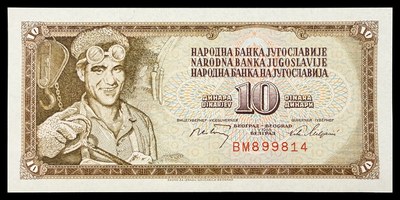
This image shows a 10 Dinara note from the National Bank of Yugoslavia dated 1.V.1968, featuring an industrial steelworker with welding goggles and protective gear, representing the socialist emphasis on industrial labor and the working class. The Yugoslav socialist state frequently celebrated workers and industrialization on its currency as symbols of national development and communist ideology.
History
MISMATCHED PAIR: The front image is a Yemen Arab Republic 1 Rial note (likely P-11 series, 1969-1973), while the back image is a Socialist Federal Republic of Yugoslavia 10 Dinara note (P-82c, dated 1 May 1968). These are two completely different banknotes from different countries. The Yemen note was issued by the Central Bank of Yemen (North Yemen) after the 1962 revolution. The Yugoslav note was part of the 1965-1968 dinar series featuring workers, printed by Zavod za Izradu Novčanica in Belgrade.