Type details
| Country | Yugoslavia |
| Currency | YUD |
| Denomination | 50 |
| Series | 1978 Series |
| Series year | 1978 |
| Series range | 1978-1986 |
| Issue year | 1978 |
| Issuer | National Bank of Yugoslavia |
| Issuer (native) | Народна Банка Југославије |
| Signatures | Zamjenik Guvernera (Deputy Governor): signature visible; Guverner (Governor): signature visible |
| Printer | Zavod za izradu novčanica, Belgrade |
| Front portrait | Worker and Peasant |
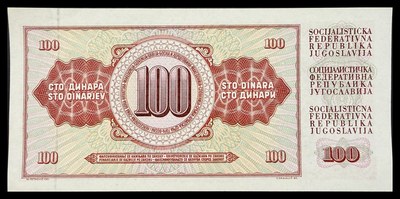
| Reverse subject | Denomination rosette with multilingual state name |
| Themes | statesman,industry,agriculture |
| Watermark | Portrait visible in clear field |
| Security features | intaglio,microprint,raised_print |
| Colour palette | #8b7355,#d4af37,#4682b4 |
| Material | paper |
| Dimensions (mm) | 154x70 |
| Language / script | Latin and Cyrillic |
| Languages | sr,sl,hr |
| Pick # | 89a |
| Rarity | common |
| Legal status | demonetized |
| Legal status date | 1990 |
| Successor currency | Yugoslav Dinar (1990 reform) |
| Era | 1946_1989 |
| Default value (low) | 2.0 |
| Default value (high) | 8.0 |
| Value currency | USD |
Front
Allegorical representation of a male worker and female peasant, symbolizing the socialist ideals of labor and agriculture in the Socialist Federal Republic of Yugoslavia. This dual portrait design was characteristic of Yugoslav currency during the socialist period, emphasizing the unity of industrial workers and rural farmers as the foundation of the socialist state. The note is issued by the Narodna Banka Jugoslavije (National Bank of Yugoslavia) with text in Latin and Cyrillic scripts reflecting the multilingual nature of the federation. Date and place of issue shown as 'Beograd - Beograd / Belgrad' dated 12.VIII.1978.
Back
Central denomination rosette displaying '100 STO DINARJEV / STO DINARA / СТО ДИНАРИ' with the full name of the issuing state 'SOCIJALISTIČKA FEDERATIVNA REPUBLIKA JUGOSLAVIJA' (Socialist Federal Republic of Yugoslavia) in Latin and Cyrillic scripts. The design emphasizes the multinational character of Yugoslavia through trilingual denomination expressions (Slovenian, Serbo-Croatian Latin, and Serbian Cyrillic). Legal tender clause visible at bottom in multiple languages.
History
This 50 dinar note belongs to the 1978 series issued by the National Bank of Yugoslavia during the socialist era under Josip Broz Tito's leadership. The Socialist Federal Republic of Yugoslavia (1945-1992) comprised six republics, and its currency reflected this diversity through multilingual text in Latin and Cyrillic scripts. The 1978 series remained in circulation through the 1980s until hyperinflation in the late 1980s led to currency reforms. The denomination discrepancy (note shows '50 DINARA' on front but '100 STO DINARA' on back) indicates this is a mismatched pair - the front is from a 50 dinar note (P-89) while the back appears to be from a 100 dinar note (P-90). The allegorical worker-peasant imagery was standard socialist iconography emphasizing the worker-peasant alliance as the foundation of the socialist state. The Zavod za izradu novčanica in Belgrade was the state printing works responsible for Yugoslav banknote production.
Linked specimens (1)
Merge into another type
Repoints every linked specimen above to the chosen target type, fills any target nulls from this type, then deletes this type. This cannot be undone.