Type details
| Country | Yugoslavia |
| Currency | Yugoslav dinar |
| Denomination | 1000 |
| Series range | 1978–1981 |
| Issue year | 1981 |
| Issuer | National Bank of Yugoslavia |
| Issuer (native) | Народна банка Југославије |
| Signatures | Zamjenik guvernera: (signature visible); Guverner: (signature visible) |
| Front portrait | Young peasant woman |
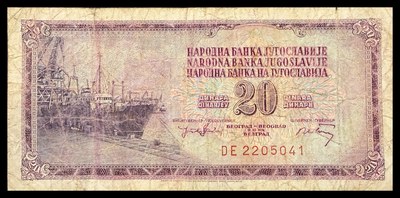
| Reverse subject | Port of Rijeka |
| Themes | agriculture,industry,transport |
| Watermark | Young woman's portrait in clear field |
| Security features | microprint,intaglio,watermark |
| Colour palette | #d4c5a8,#8b7355,#2f2f2f |
| Material | paper |
| Dimensions (mm) | 165x80 |
| Language / script | Cyrillic,Latin |
| Languages | sr,mk |
| Pick # | 92c |
| Rarity | common |
| Legal status | demonetized |
| Legal status date | 1992 |
| Successor currency | Yugoslav dinar (1992 reform) |
| Era | 1946_1989 |
| Default value (low) | 2.0 |
| Default value (high) | 8.0 |
| Value currency | USD |
Front
Portrait of a young peasant woman representing the working people of Yugoslavia, a recurring motif on Yugoslav banknotes symbolizing the socialist ideal of labor and agricultural productivity. The background depicts agricultural scenes with grape harvest, vineyards, a riverboat on the Danube, and rural landscapes, emphasizing Yugoslavia's agricultural economy. The note is trilingual (Serbian Cyrillic, Latin, and Macedonian Cyrillic) reflecting the multinational character of the Socialist Federal Republic of Yugoslavia. Date printed: 4.XI.1981 (November 4, 1981), issued under the governorship during the post-Tito period.
Back
Port of Rijeka (Rijeka Harbor), Yugoslavia's principal seaport on the Adriatic Sea in Croatia. The scene shows cargo ships, cranes, and port infrastructure, symbolizing Yugoslavia's maritime trade and industrial capacity. Rijeka was the largest cargo port in Yugoslavia and a vital gateway for the country's exports and imports during the socialist era. Date printed: 19.XII.1974 (December 19, 1974), indicating this is an earlier plate design still in use for the 1981 printing.
History
This 1000 dinara note was issued by the National Bank of Yugoslavia on November 4, 1981, during the period following Josip Broz Tito's death in May 1980. The note belongs to a series issued between 1978 and 1981, characterized by themes of labor, agriculture, and industry reflecting socialist Yugoslavia's economic priorities. The trilingual inscriptions (Serbian Cyrillic, Latin script, and Macedonian Cyrillic) represent the country's complex federal structure comprising six republics and two autonomous provinces. The back plate is dated December 19, 1974, indicating reuse of earlier printing plates. Yugoslavia experienced increasing inflation throughout the 1980s, and the dinar underwent several reforms before the country's dissolution in 1992. This note was demonetized following the breakup of Yugoslavia and the establishment of successor states with independent currencies.
Linked specimens (1)
Merge into another type
Repoints every linked specimen above to the chosen target type, fills any target nulls from this type, then deletes this type. This cannot be undone.