Type details
| Country | Yugoslavia |
| Currency | Yugoslav Dinar |
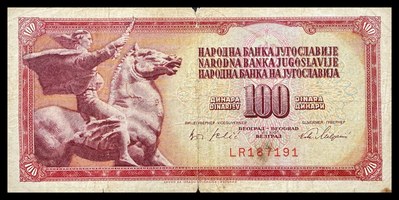
| Denomination | 20 Dinara (front) / 100 Dinara (back) |
| Issuer | Narodna Banka Jugoslavije |
| Issuer (native) | Народна Банка Југославије |
| Signatures | Viceguverner; Guverner |
| Printer | Zavod za izradu novcanica, Beograd |
| Reverse subject | The Horses of Lysippos sculpture |
| Themes | statesman,architecture |
| Security features | microprint,intaglio |
| Colour palette | #8b4789,#f5deb3,#8b0000 |
| Material | paper |
| Language / script | Latin, Cyrillic |
| Languages | sr,hr,sl,mk |
| Legal status | demonetized |
| Successor currency | New Dinar |
| Era | 1946_1989 |
Front
This note displays the denomination '20 Dinara' in ornate guilloche design with the text 'SOCIJALISTICKA FEDERATIVNA REPUBLIKA JUGOSLAVIJA' (Socialist Federal Republic of Yugoslavia) in Latin, Cyrillic, and Slovenian scripts. The denomination appears four times in different languages reflecting Yugoslavia's multilingual character: Serbian, Croatian/Bosnian, Slovenian, and Macedonian. The elaborate security printing includes rosettes and geometric patterns typical of socialist-era Yugoslav currency.
Back
The Horses of Lysippos (Horses of Saint Mark), a famous quadriga sculpture originally created by Greek sculptor Lysippos in the 4th century BCE. These bronze horses have stood atop St Mark's Basilica in Venice since the 13th century and are among the most celebrated examples of classical sculpture. The denomination shown on the reverse is '100 Dinara', issued by Narodna Banka Jugoslavije (National Bank of Yugoslavia). The date printed is 'XVII 1965', indicating the note was issued in 1965. Signatures of the Vice-Governor and Governor are present, printed in Belgrade.
History
This note presents a significant mismatch between front and back images. The front shows a 20 Dinara design while the back shows 100 Dinara dated 1965. The 100 Dinara reverse from 1965 is a well-documented issue (Pick #80) from the SFR Yugoslavia series issued during the Tito era, featuring the Horses of Saint Mark. The multilingual inscriptions reflect Yugoslavia's federal structure with six republics and multiple official languages. This currency series was part of the post-WWII Yugoslav dinar that circulated until various reforms in the 1990s following the country's dissolution. The visible date 'XVII 1965' on the back indicates this specific 100 Dinara note was issued in 1965. Without a clear match between front and back, attribution of the 20 Dinara front is uncertain.
Linked specimens (1)
Merge into another type
Repoints every linked specimen above to the chosen target type, fills any target nulls from this type, then deletes this type. This cannot be undone.