Type details
| Country | Zimbabwe |
| Currency | ZWD |
| Denomination | 5 Dollars |
| Issuer | Reserve Bank of Zimbabwe |
| Reverse subject | Jan van Riebeeck |
| Themes | architecture,wildlife,indigenous_culture |
| Security features | intaglio,microprint |
| Colour palette | #8b4513,#d2b48c,#6b8e23 |
| Material | paper |
| Language / script | Latin |
| Languages | en,af |
| Legal status | demonetized |
| Legal status date | 2009 |
| Predecessor currency | Rhodesian Dollar |
| Successor currency | Zimbabwe Dollar (fourth) |
| Era | 1990_present |
Front
The Chiremba Balancing Rocks (also known as the Epworth Balancing Rocks), a distinctive geological formation of balanced granite boulders located near Harare, Zimbabwe. These rocks are one of Zimbabwe's most iconic natural landmarks and appear on multiple denominations of Zimbabwean currency as a national symbol. The front features stylized indigenous animals including elephants in the decorative border, with traditional geometric patterns in green, brown, and multicolor.
Back
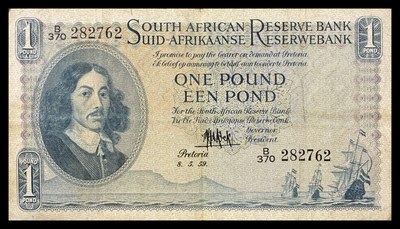
Jan van Riebeeck (1619–1677), Dutch colonial administrator who founded the Cape Colony settlement in 1652, establishing the first permanent European settlement in South Africa. The back depicts a historical sailing ship scene representing early colonial maritime activity at the Cape of Good Hope. This note is a mismatched pair: the back is from a South African Reserve Bank 1 Pound note dated 8.5.59 (May 8, 1959), serial number B/o 282762, issued in Pretoria. The bilingual text 'SOUTH AFRICAN RESERVE BANK / SUID-AFRIKAANSE RESERWEBANK' and promise to pay in English and Afrikaans confirms this is a South African note, NOT the reverse of the Zimbabwean 5 Dollar front.
History
CRITICAL MISMATCH: These images show two different banknotes from two different countries and eras. The front is a Reserve Bank of Zimbabwe 5 Dollar note featuring the Chiremba Balancing Rocks, likely from the 1990s or early 2000s Zimbabwe Dollar series (first or second dollar, before hyperinflation). The back is a South African Reserve Bank 1 Pound note from 1959, part of the pre-decimal South African pound series issued before the transition to the Rand in 1961. The South African pound was the currency of the Union of South Africa from 1910–1961. This appears to be either an error in image pairing or the two sides of different notes were photographed. Zimbabwe (formerly Southern Rhodesia) and South Africa are distinct countries with separate currencies and issuing authorities. The Zimbabwean Dollar underwent multiple series and redenominations, ultimately collapsing during hyperinflation (2007–2009) and being abandoned in 2009 in favor of multi-currency use.
Linked specimens (1)
Merge into another type
Repoints every linked specimen above to the chosen target type, fills any target nulls from this type, then deletes this type. This cannot be undone.