50 Dollars (front) / 100 Dollars (back) ZWD #621
Bearer Cheque series (2006–2008) · issued 2006
Type details
| Country | Zimbabwe |
| Currency | ZWD |
| Denomination | 50 Dollars (front) / 100 Dollars (back) |
| Series | Bearer Cheque series |
| Series year | 2006 |
| Series range | 2006–2008 |
| Issue year | 2006 |
| Issuer | Reserve Bank of Zimbabwe |
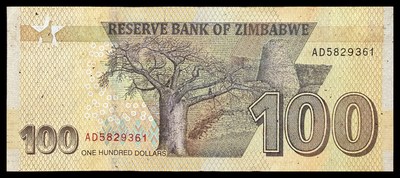
| Reverse subject | Baobab tree and rural landscape with traditional granaries |
| Themes | wildlife,agriculture,indigenous_culture,architecture |
| Watermark | Zimbabwe Bird in clear field at left |
| Security features | watermark,microprint,intaglio,see_through_register |
| Colour palette | #d4a574,#8b4513,#f5deb3 |
| Material | paper |
| Language / script | Latin |
| Languages | en |
| Legal status | demonetized |
| Legal status date | 2009 |
| Predecessor currency | Zimbabwean Dollar (first) |
| Successor currency | Zimbabwean Dollar (third redenomination, ZWL) |
| Era | 1990_present |
Front
Family scene depicting traditional Zimbabwean life with mother and child in rural setting. This note belongs to the hyperinflation-era bearer cheque series issued by the Reserve Bank of Zimbabwe during the economic crisis of the mid-2000s when inflation rendered conventional currency denominations obsolete almost immediately upon issue.
Back
Baobab tree (Adansonia digitata) in African savanna landscape with traditional grain storage structures (granaries) visible in the background. The baobab, known as the 'tree of life,' is an iconic symbol of Zimbabwe and southern Africa, and the scene represents the country's agricultural heritage and rural life. The traditional thatched granaries reflect indigenous Shona architectural practices for food storage.
History
This is a mismatched pair: the front is a 50 Dollars note (serial AG8793015) and the back is a 100 Dollars note (serial AD5829361), both from Zimbabwe's hyperinflation period (2006–2008). During this era, the Reserve Bank of Zimbabwe issued 'bearer cheques' and 'agro-cheques' as emergency currency as hyperinflation spiraled out of control, eventually reaching an estimated peak of 89.7 sextillion percent year-on-year in November 2008. The denomination mismatch suggests these images are from separate notes rather than front/back of the same specimen. The Zimbabwe Dollar was eventually abandoned in 2009 in favor of foreign currencies including the US Dollar and South African Rand. The serial prefixes (AG, AD) indicate different print runs. The Zimbabwe Bird watermark is a national symbol derived from soapstone sculptures found at Great Zimbabwe ruins.
Linked specimens (1)
Merge into another type
Repoints every linked specimen above to the chosen target type, fills any target nulls from this type, then deletes this type. This cannot be undone.