50000 ZWD #625
Second Dollar hyperinflation series
(2006–2009)
· issued 2008
· 73
· common
Type details
| Country | Zimbabwe |
| Currency | ZWD |
| Denomination | 50000 |
| Series | Second Dollar hyperinflation series |
| Series year | 2008 |
| Series range | 2006–2009 |
| Issue year | 2008 |
| Issuer | Reserve Bank of Zimbabwe |
| Signatures | Governor: Dr. G. Gono |
| Reverse subject | Balancing Rocks |
| Themes | architecture,industry |
| Security features | microprint,intaglio,latent_image |
| Colour palette | #d4b896,#8b4513,#556b2f |
| Material | paper |
| Dimensions (mm) | 145x72 |
| Language / script | Latin |
| Languages | en |
| Pick # | 73 |
| Rarity | common |
| Legal status | demonetized |
| Legal status date | 2009-04-12 |
| Predecessor currency | First Zimbabwean Dollar |
| Successor currency | Third Zimbabwean Dollar |
| Era | 1990_present |
| Default value (low) | 1.0 |
| Default value (high) | 5.0 |
| Value currency | USD |
Front
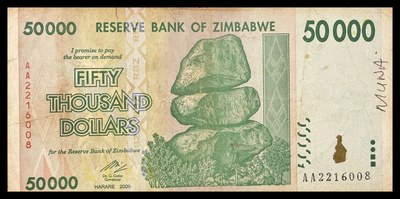
Kariba Dam hydroelectric facility on the Zambezi River, one of Africa's largest dams. Built between 1955–1959 as a joint project between Northern and Southern Rhodesia (now Zambia and Zimbabwe), the dam represents industrial development and provides electricity to both countries. The dam's construction was one of the major engineering achievements of colonial Africa and remains a symbol of Zimbabwe's infrastructure.
Back
Balancing Rocks (Chiremba Balancing Rocks near Harare), a geological formation of naturally balanced granite boulders that has been Zimbabwe's national symbol since independence. These rocks appeared on the Zimbabwean flag from 1980–2023 and have featured on every series of Zimbabwean currency. The formation represents stability and resilience, key themes in Zimbabwean national identity. The rocks are found throughout Zimbabwe's granite-rich terrain and hold cultural significance.
History
This note belongs to the Second Dollar hyperinflation series (2006–2009), issued during Zimbabwe's catastrophic economic collapse under Robert Mugabe's government. By 2008, Zimbabwe experienced one of the worst hyperinflations in recorded history, with inflation exceeding 231 million percent. The 50,000 dollar note, printed in Harare in 2008 under Governor Gideon Gono's tenure, was part of the emergency issuance of progressively higher denominations as the currency collapsed. The Reserve Bank eventually issued notes up to 100 trillion dollars before abandoning the currency in 2009 and adopting a multi-currency system (primarily USD and South African rand). The Second Dollar was redenominated from the First Dollar at a rate of 1:1000 in August 2006. Governor Gono's signature appears on most hyperinflation-era notes. This denomination became near-worthless within months of issue. The note was demonetized on April 12, 2009 when Zimbabwe officially suspended its currency.
Linked specimens (1)
Merge into another type
Repoints every linked specimen above to the chosen target type, fills any target nulls from this type, then deletes this type. This cannot be undone.