Type details
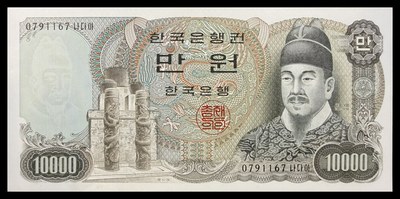
| Country | South Korea |
| Currency | KRW |
| Denomination | 10000 |
| Series | Fourth series |
| Series range | 1973-1983 |
| Issuer | Bank of Korea |
| Issuer (native) | 한국은행 |
| Reverse subject | Gyeonghoeru Pavilion |
| Themes | architecture |
| Security features | microprint,intaglio |
| Colour palette | #d4c5a8,#8b7355,#f5e6d3 |
| Material | paper |
| Dimensions (mm) | 161x76 |
| Language / script | Latin, Hangul |
| Languages | en,ko |
| Pick # | 37 |
| Rarity | common |
| Legal status | demonetized |
| Legal status date | 1983 |
| Predecessor currency | Hwan |
| Era | 1946_1989 |
Front
Gyeonghoeru Pavilion (Gyeongbokgung Palace, Seoul), a two-story pavilion built in 1412 during the Joseon Dynasty reign of King Taejong. The pavilion served as a state banquet hall and is considered one of the largest surviving examples of Joseon palace architecture. The structure sits on 48 stone pillars above a lotus pond and represents the architectural grandeur of the early Joseon period. This pavilion was selected as the primary motif for Korea's highest denomination note of the fourth series to symbolize national heritage and cultural dignity.
History
Fourth series Bank of Korea notes issued 1973-1983, replacing the third series during a period of rapid economic development under President Park Chung-hee. The 10,000 won note was the highest denomination of this series. This series featured traditional Korean architectural landmarks rather than portraits, reflecting a focus on cultural heritage. The note was withdrawn from circulation in 1983 when the Bank of Korea introduced a fifth series with enhanced security features. The fourth series circulated during Korea's industrialization era and the transition from an agricultural to a manufacturing economy.
Linked specimens (1)
Merge into another type
Repoints every linked specimen above to the chosen target type, fills any target nulls from this type, then deletes this type. This cannot be undone.