Type details
| Country | Iraq |
| Currency | IQD |
| Denomination | 25 |
| Series range | 1990–2003 |
| Issuer | Central Bank of Iraq |
| Issuer (native) | البنك المركزي العراقي |
| Themes | architecture |
| Security features | microprint,intaglio |
| Colour palette | #a8c9a4,#8b7355,#d4c5a0 |
| Material | paper |
| Dimensions (mm) | 140x65 |
| Language / script | Arabic (front), Hebrew (back) |
| Languages | ar,he |
| Pick # | 73 |
| Rarity | common |
| Legal status | demonetized |
| Legal status date | 2003 |
| Successor currency | New Iraqi Dinar |
| Era | 1990_present |
Front
The Abbasid Palace (Al-Qasr al-Abbasi) in Baghdad, a restored medieval palace dating from the late 12th or early 13th century during the Abbasid Caliphate. The palace features characteristic Islamic architectural elements including pointed arches, iwans (vaulted halls), and ornate brickwork. It served as one of the few surviving examples of Abbasid secular architecture in Baghdad and was used as a museum. The Arabic inscription identifies the issuing authority as the Central Bank of Iraq.
Back
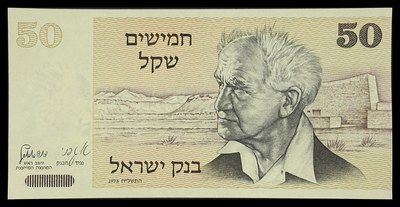
This appears to show a mismatched back — the reverse depicts David Ben-Gurion (1886–1973), the primary founder and first Prime Minister of Israel, shown in profile with the Negev desert landscape and what appears to be Sde Boker (his kibbutz retirement home) in the background. The Hebrew text reads 'Bank of Israel' (בנק ישראל) and 'Fifty Sheqalim' (חמישים שקל). The date shown is 1978 (התשל״ח). This is an Israeli 50 Sheqalim note, NOT the reverse of the Iraqi 25 Dinars note shown on the front.
History
The front shows an Iraqi 25 Dinars note from the Saddam Hussein era, likely issued in the 1990s based on the design style and the Central Bank of Iraq designation. This series continued until 2003 when it was demonetized following the fall of the Ba'athist regime and replaced by new currency issued by the Coalition Provisional Authority. The Abbasid Palace motif was commonly used on Iraqi currency to emphasize the country's historical role as the center of the Islamic Golden Age under the Abbasid Caliphate. The back image is clearly from a different banknote entirely — an Israeli 50 Sheqalim note from 1978 featuring David Ben-Gurion. This represents a mismatched pair of images from two completely different countries and currency systems.
Linked specimens (1)
Merge into another type
Repoints every linked specimen above to the chosen target type, fills any target nulls from this type, then deletes this type. This cannot be undone.