Type details
| Country | Japan |
| Currency | Yen |
| Denomination | 50 Sen |
| Series | Shōwa 13 series |
| Series year | 1938 |
| Series range | 1938–1948 |
| Issue year | 1938 |
| Issuer | Imperial Japanese Government |
| Issuer (native) | 大日本帝國政府 |
| Printer | Ministry of Finance Printing Bureau |
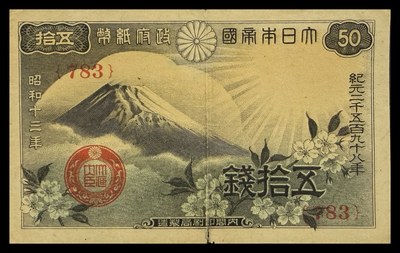
| Reverse subject | Mount Fuji |
| Themes | architecture,nature |
| Watermark | Chrysanthemum crest visible in clear field |
| Security features | microprint,intaglio |
| Colour palette | #d4c5a0,#8b7355,#f5e6d3 |
| Material | paper |
| Dimensions (mm) | 105x62 |
| Language / script | Japanese (Kanji, Hiragana) |
| Languages | ja |
| Pick # | P-59 |
| Rarity | common |
| Legal status | demonetized |
| Legal status date | 1953 |
| Successor currency | Yen (revalued 1946) |
| Era | 1900_1945 |
| Default value (low) | 5.0 |
| Default value (high) | 20.0 |
| Value currency | USD |
Front
The front features the denomination '50' prominently displayed within geometric guilloche patterns. The note displays the imperial chrysanthemum crest (kikumon), the 16-petaled symbol of the Japanese Imperial family which has appeared on Japanese currency since ancient times. The denomination is expressed in sen, a subunit of the yen (1/100 yen). Intricate wave-pattern borders frame the design.
Back
Mount Fuji (Fujisan), Japan's highest and most sacred mountain at 3,776 meters, dominates the reverse design with cherry blossoms (sakura) in the foreground. Mount Fuji has been a symbol of Japan for centuries and appears frequently on Japanese banknotes as an emblem of national identity. The chrysanthemum crest appears at top center, with text reading '大日本帝國政府紙幣' (Great Empire of Japan Government Note) and denomination '五拾錢' (50 sen). A red seal with the chrysanthemum crest appears at left. The serial number '783' in red appears twice.
History
This 50 sen note belongs to the Shōwa 13 (1938) series, issued during Emperor Hirohito's reign and the Second Sino-Japanese War period. The series was introduced in 1938 (Shōwa year 13 in the Japanese calendar) and remained in circulation through WWII and into the early postwar period until 1948. After Japan's defeat in 1945, massive inflation devalued the currency; the Bank of Japan Act of 1946 created the post-war yen at 1:1 parity but emergency measures in 1946 effectively revalued currency. These pre-war government notes were gradually withdrawn and demonetized by 1953. The sen denomination (1/100 yen) ceased to be used after 1953 due to inflation. The note was printed by the Ministry of Finance Printing Bureau (later the National Printing Bureau). Pick P-59 is well-documented and relatively common in numismatic markets.
Linked specimens (1)
Merge into another type
Repoints every linked specimen above to the chosen target type, fills any target nulls from this type, then deletes this type. This cannot be undone.