Type details
| Country | Jamaica |
| Currency | Jamaican Dollar |
| Denomination | 50 Dollar |
| Issuer | Bank of Jamaica |
| Printer | Thomas De La Rue and Company Limited |
| Reverse subject | Doctor's Cave Beach |
| Themes | architecture |
| Colour palette | #d4c5a0,#8b4c4c,#4a4a3a |
| Material | paper |
| Language / script | Latin |
| Languages | en |
Front
Doctor's Cave Beach in Montego Bay, Jamaica. This famous beach became internationally known in the 1920s after Dr. Alexander McCatty donated the land for public bathing, and claims of the healing properties of its waters attracted tourists from around the world. The beach has been central to Jamaica's tourism industry and appears on this Bank of Jamaica fifty dollar note as a symbol of the island's natural beauty and economic importance of tourism.
Back
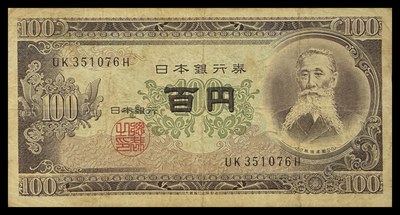
Portrait of Itō Hirobumi (1841–1909), Japanese statesman and four-time Prime Minister of Japan, who played a crucial role in the Meiji Restoration and modernization of Japan. He was the principal author of the Meiji Constitution of 1889 and served as Japan's first Prime Minister. The text reads '日本銀券' (Bank of Japan Note) and '百円' (100 yen). The serial number UK351076H is visible, along with ornate decorative patterns typical of early to mid-20th century Japanese banknote design.
History
This appears to be a mismatched pair of banknotes. The front image shows a Bank of Jamaica $50 note featuring Doctor's Cave Beach with text 'THOMAS DE LA RUE AND COMPANY LIMITED' at the bottom, indicating it was printed by the renowned British security printer De La Rue. This note belongs to one of Jamaica's earlier currency series from the post-independence era. The back image shows a Bank of Japan 100 yen note from the Series C period (1953–1974), featuring Itō Hirobumi. These are clearly two different banknotes from different countries, denominations, and time periods that have been photographed together. The Jamaica note likely dates from the 1960s–1980s period based on the design style and De La Rue printing. The Japanese note is from the mid-20th century based on Itō Hirobumi's appearance on 100 yen notes during that era.
Linked specimens (1)
Merge into another type
Repoints every linked specimen above to the chosen target type, fills any target nulls from this type, then deletes this type. This cannot be undone.