Type details
| Country | Brazil |
| Currency | BRZ |
| Denomination | 500 |
| Series | Cruzado series |
| Series range | 1986–1989 |
| Issuer | Banco Central do Brasil |
| Issuer (native) | BANCO CENTRAL DO BRASIL |
| Signatures | Presidente do Conselho Monetário Nacional: signature present; Presidente do Banco Central do Brasil: signature present |
| Printer | Casa da Moeda do Brasil |
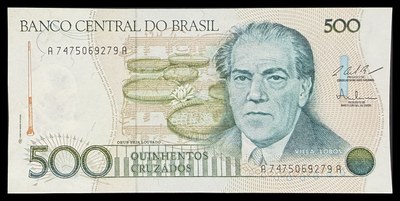
| Front portrait | Heitor Villa-Lobos |
| Reverse subject | Villa-Lobos conducting |
| Themes | artist,music,culture |
| Watermark | Portrait of Villa-Lobos in clear field at left |
| Security features | watermark,intaglio,microprint,thread |
| Colour palette | #a8c5b5,#d4c8a0,#6b8e7f |
| Material | paper |
| Dimensions (mm) | 140x65 |
| Language / script | Latin |
| Languages | pt |
| Pick # | 212 |
| Rarity | common |
| Legal status | demonetized |
| Legal status date | 1990-03-16 |
| Predecessor currency | Cruzeiro (1970–1986) |
| Successor currency | Cruzado Novo |
| Era | 1946_1989 |
| Default value (low) | 2.0 |
| Default value (high) | 8.0 |
| Value currency | USD |
Front
Heitor Villa-Lobos (1887–1959), Brazilian composer, conductor and cellist who became the most significant creative figure in 20th-century Brazilian classical music. He wrote over 2,000 works, incorporating Brazilian folk and indigenous elements into classical forms, and founded the Brazilian Academy of Music. The note also depicts the Victoria regia (giant water lily), a symbol of Amazonian flora.
Back
Villa-Lobos conducting with baton raised, shown in profile against a background of stylized vegetation. The scene captures his role as conductor and educator, reflecting his work in musical education throughout Brazil and his international conducting career that brought Brazilian music to world prominence.
History
The Cruzado series (1986–1989) was introduced during the Plano Cruzado economic reform under President José Sarney, replacing the Cruzeiro at a rate of 1,000:1 in an attempt to combat hyperinflation. The 500 Cruzados denomination honored Villa-Lobos as part of Brazil's practice of featuring cultural and scientific figures on its currency. The Cruzado itself was short-lived, replaced by the Cruzado Novo in 1989 and ultimately by the return of the Cruzeiro in 1990, as hyperinflation continued.
Linked specimens (1)
Merge into another type
Repoints every linked specimen above to the chosen target type, fills any target nulls from this type, then deletes this type. This cannot be undone.