Type details
| Country | Hungary |
| Currency | Pengő |
| Denomination | 100 |
| Series | Second Pengő series |
| Series year | 1930 |
| Series range | 1930-1944 |
| Issue year | 1930 |
| Issuer | Magyar Nemzeti Bank |
| Issuer (native) | Magyar Nemzeti Bank |
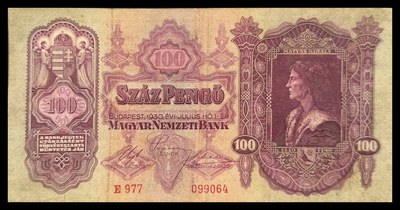
| Front portrait | Mátyás Király |
| Reverse subject | Buda Castle |
| Themes | monarch,architecture,statesman |
| Security features | intaglio,microprint |
| Colour palette | #8b5a7a,#d4af8e,#6b4958 |
| Material | paper |
| Dimensions (mm) | 175x115 |
| Language / script | Latin |
| Languages | hu |
| Pick # | P-98 |
| Rarity | common |
| Legal status | demonetized |
| Legal status date | 1946-08-01 |
| Predecessor currency | Korona |
| Successor currency | Forint |
| Era | 1900_1945 |
| Default value (low) | 10.0 |
| Default value (high) | 25.0 |
| Value currency | USD |
Front
Mátyás Király (Matthias Corvinus, 1443–1490), King of Hungary and Croatia from 1458 to 1490, one of the most celebrated rulers in Hungarian history. His reign is remembered as a golden age of Hungarian culture and military power; he established one of Europe's finest Renaissance courts and the famous Bibliotheca Corviniana. The note bears the inscription 'BUDAPEST, 1930 ÉVI JÚLIUS HÓ 1-ÉN' (Budapest, 1 July 1930) and features the Hungarian coat of arms with two angels at left.
Back
Buda Castle (Royal Palace of Buda) on Castle Hill in Budapest, the historical residence of Hungarian kings. The complex has been rebuilt multiple times since the 13th century, serving as the seat of Hungarian monarchs including Matthias Corvinus. Depicted here in its pre-WWII form, topped with a Turul bird (a mythological falcon-like bird from Hungarian tradition and heraldic symbol).
History
Part of the Second Pengő series issued by Magyar Nemzeti Bank from 1930. The Pengő was introduced in 1927 to replace the hyperinflated Korona at a rate of 12,500:1. This 100 pengő note featuring Matthias Corvinus was in circulation until the catastrophic hyperinflation of 1945-1946, when the Pengő became the currency with the highest ever recorded inflation. It was replaced by the Forint on 1 August 1946. The 1930 series represented Hungary's interwar monetary stability before the economic devastation of World War II.
Linked specimens (1)
Merge into another type
Repoints every linked specimen above to the chosen target type, fills any target nulls from this type, then deletes this type. This cannot be undone.