Type details
| Country | Bulgaria |
| Currency | BGN |
| Denomination | 50 |
| Series | Third lev series |
| Series year | 1992 |
| Series range | 1992–1999 |
| Issue year | 1992 |
| Issuer | Bulgarian National Bank |
| Issuer (native) | Българска народна банка |
| Signatures | Upravitel: Ga. Yusnier |
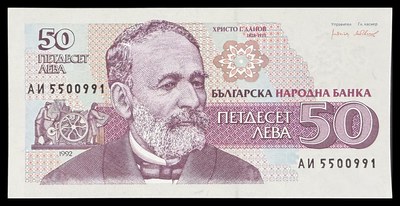
| Front portrait | Hristo Smirnenski |
| Reverse subject | Traditional weaving loom |
| Themes | writer,industry,indigenous_culture |
| Watermark | Portrait of Hristo Smirnenski in clear field at right |
| Security features | thread,microprint,intaglio |
| Colour palette | #b08090,#e8d8c8,#4a3040 |
| Material | paper |
| Dimensions (mm) | 140x70 |
| Language / script | Cyrillic |
| Languages | bg |
| Pick # | 102 |
| Rarity | common |
| Legal status | demonetized |
| Legal status date | 1999-07-05 |
| Predecessor currency | Second lev |
| Successor currency | Fourth lev |
| Era | 1990_present |
| Default value (low) | 2.0 |
| Default value (high) | 8.0 |
| Value currency | USD |
Front
Hristo Smirnenski (1898–1923), Bulgarian poet, prose writer and journalist who was a major figure of the interwar literary avant-garde. Known for his expressionist poetry and social criticism, Smirnenski died of tuberculosis at age 25; his works addressed themes of social injustice and became influential in Bulgarian literature. The note features his portrait at center with dates 1898–1923, alongside decorative folk motifs.
Back
Traditional Bulgarian wooden weaving loom (станче), representing the country's rich textile heritage and folk crafts. The loom symbolizes Bulgaria's agricultural and artisan traditions, particularly the production of hand-woven textiles that have been central to village life for centuries. Multicolored decorative patterns appear in the background, evoking traditional Bulgarian embroidery and textile designs.
History
This note belongs to the third lev series, issued by the Bulgarian National Bank in 1992 following the democratic transition after 1989. The series replaced the second lev series and circulated during a period of economic turbulence and hyperinflation in Bulgaria. It was superseded in 1999 when the fourth lev was introduced at a rate of 1,000:1 due to severe currency devaluation. The denomination of 50 leva was modest but represented meaningful value in the early 1990s post-communist economy. Smirnenski's inclusion reflected the new regime's embrace of cultural figures rather than exclusively political leaders.
Linked specimens (1)
Merge into another type
Repoints every linked specimen above to the chosen target type, fills any target nulls from this type, then deletes this type. This cannot be undone.