100 Soviet Ruble #89
State Bank of the USSR Issue of 1961
(1961–1991)
· issued 1961
· P-235a
· common
Type details
| Country | Soviet Union |
| Currency | Soviet Ruble |
| Denomination | 100 |
| Series | State Bank of the USSR Issue of 1961 |
| Series year | 1961 |
| Series range | 1961–1991 |
| Issue year | 1961 |
| Issuer | State Bank of the USSR |
| Issuer (native) | Государственного Банка СССР |
| Printer | Goznak |
| Front portrait | Vladimir Lenin |
| Reverse subject | Kremlin Spasskaya Tower |
| Themes | statesman,architecture,commemorative |
| Watermark | Hammer and sickle with star in clear field |
| Security features | microprint,intaglio,latent_image |
| Colour palette | #d4a574,#8b6f47,#f5e6d3 |
| Material | paper |
| Dimensions (mm) | 150x65 |
| Language / script | Cyrillic |
| Languages | ru,be,uz,kk,ka,az,lt,lv,et,mo,ky,tg,hy,tk,uk |
| Pick # | P-235a |
| Rarity | common |
| Legal status | demonetized |
| Legal status date | 1991 |
| Predecessor currency | Soviet Ruble (1947 series) |
| Successor currency | Russian Ruble |
| Era | 1946_1989 |
| Default value (low) | 5.0 |
| Default value (high) | 15.0 |
| Value currency | USD |
Front
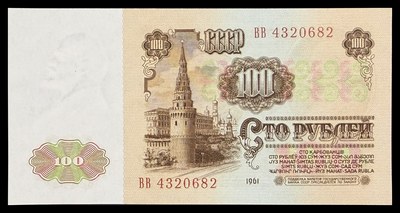
The Spasskaya Tower of the Moscow Kremlin, the most iconic of the Kremlin towers, built in 1491 by Italian architect Pietro Antonio Solari and crowned with its distinctive star in Soviet times. The tower houses the famous Kremlin chimes and serves as the main ceremonial entrance to the Kremlin; it became a symbol of Soviet state power and appears on numerous Soviet banknotes and stamps. Text in multiple languages of Soviet republics confirms the multinational character of the USSR.
Back
Vladimir Ilyich Lenin (1870–1924), founder of the Soviet state and leader of the Bolshevik Revolution of 1917. Lenin served as head of the Soviet government from 1917 until his death and remains the most frequently depicted figure in Soviet numismatics. The State Emblem of the USSR with hammer, sickle, and red star surrounded by wheat sheaves appears at center, representing the unity of Soviet republics.
History
State Bank of the USSR Issue of 1961, part of the currency reform that replaced the 1947 series at a ratio of 10:1 (old rubles to new rubles). This reform was implemented to combat inflation and black market activity following post-war reconstruction. The 1961 series remained in circulation until the dissolution of the Soviet Union in 1991, when it was replaced by Russian Federation currency. The 100-ruble note was among the highest denominations in regular circulation during the Soviet period and featured consistent iconography across all denominations: Lenin on the reverse and Soviet architectural landmarks on the obverse. Multilingual text reflected the fifteen Soviet republics. Printed by Goznak (Гознак), the state security printing works.
Linked specimens (1)
Merge into another type
Repoints every linked specimen above to the chosen target type, fills any target nulls from this type, then deletes this type. This cannot be undone.