Type details
| Country | Bulgaria |
| Currency | BGN |
| Denomination | 5 |
| Series | Issue of 1974 |
| Series year | 1974 |
| Series range | 1974–1991 |
| Issue year | 1974 |
| Issuer | Bulgarian National Bank |
| Issuer (native) | Българска народна банка |
| Printer | Goznak |
| Reverse subject | Coat of arms of People's Republic of Bulgaria |
| Themes | statesman,architecture,commemorative |
| Watermark | Star symbol at center |
| Security features | microprint,intaglio |
| Colour palette | #d4a574,#8b4513,#f5deb3 |
| Material | paper |
| Dimensions (mm) | 145x73 |
| Language / script | Cyrillic |
| Languages | bg |
| Pick # | 95 |
| Rarity | common |
| Legal status | demonetized |
| Legal status date | 1991 |
| Predecessor currency | Bulgarian Lev (1962 issue) |
| Successor currency | New Bulgarian Lev |
| Era | 1946_1989 |
| Default value (low) | 1.0 |
| Default value (high) | 3.0 |
| Value currency | USD |
Front
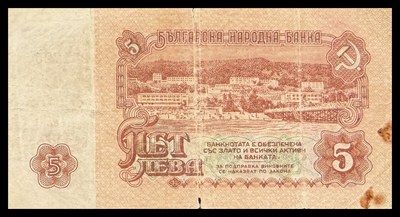
Panoramic view of an urban/industrial center showing modern apartment buildings and factories in socialist Bulgaria. The cityscape represents the industrialization and urban development promoted during the communist era of the People's Republic of Bulgaria (1946–1990), emphasizing economic progress and socialist construction. The note features characteristic socialist design motifs including hammer and sickle symbols and ornate decorative borders typical of Eastern Bloc currency design in this period.
Back
Coat of arms of the People's Republic of Bulgaria (1946–1990), featuring the lion rampant within a wreath of wheat, topped with a red star, symbolizing communist rule. The emblem was adopted in 1948 and used until the fall of communism in 1989. The arms represent the agricultural and socialist character of the state during the period when Bulgaria was aligned with the Soviet Union and part of the Warsaw Pact.
History
This note belongs to the Issue of 1974 series issued by the Bulgarian National Bank (BNB) during the socialist period of the People's Republic of Bulgaria. The series remained in circulation until 1991, when Bulgaria transitioned to democracy and introduced currency reforms following the collapse of communism. The 5 leva denomination was a standard working-class note during this period. The design reflects socialist aesthetic principles with industrial imagery and state symbols. These notes were printed by Goznak in the Soviet Union, as was common for Eastern Bloc currencies during the Cold War era.
Linked specimens (1)
Merge into another type
Repoints every linked specimen above to the chosen target type, fills any target nulls from this type, then deletes this type. This cannot be undone.