Collection › Ecuador › #169
5 Sucre
P-121a
Needs review
✦ AI 90%
The AI flagged these for your attention. Use ✦ Fact-check to cross-check factual fields against another model's world-knowledge, or 🔍 Re-look at image when you suspect the AI misread the pixels.
-
Some fields the AI was unsure about — please verify:
- Series year: “—” (0%)
Click ✦ Ask AI to verify or fix any below. -
Overall AI confidence is 90% (auto-approve threshold is 92%).Skim the Identity tab; the dots next to each field show what the AI was unsure about.
IMG_6387.jpeg
cropped
IMG_6388.jpeg
cropped
Where & when
What's on the note
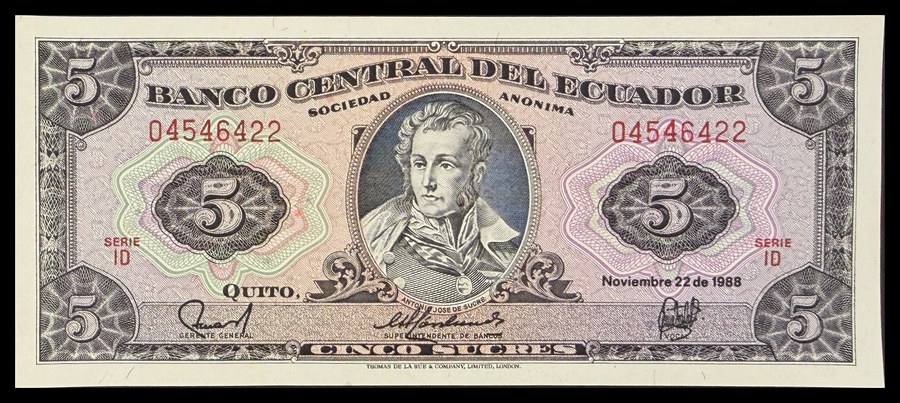
Front: Antonio José de Sucre (1795–1830), Venezuelan-born independence leader and Grand Marshal of Ayacucho, who served as the second President of Bolivia and played a key role in liberating Ecuador, Peru, and Bolivia from Spanish rule. Sucre was a trusted lieutenant of Simón Bolívar and is considered one of South America's greatest military strategists; Ecuador named its currency after him from 1884 to 2000. The note is dated November 22, 1988 (Noviembre 22 de 1988) and bears the designation 'Serie 1D' with serial number 04546422.
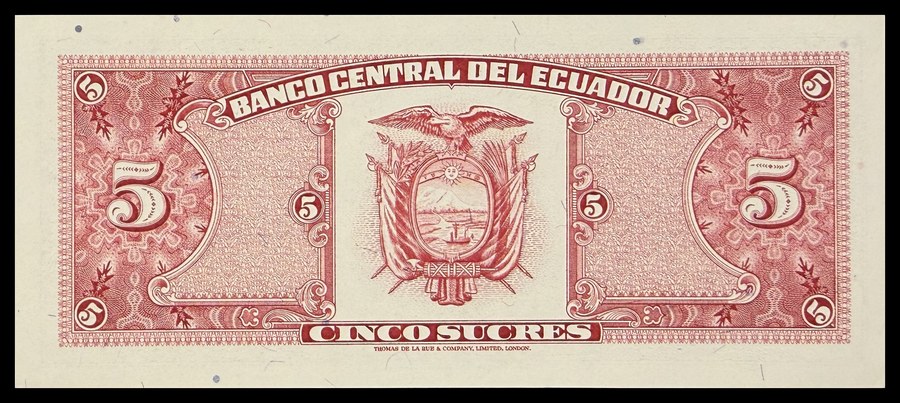
Back: The national coat of arms of Ecuador, featuring Mount Chimborazo, the Guayas River with a steamship, a sun representing the months of the March Revolution, a condor with spread wings, four national flags, and fasces representing republican dignity. The coat of arms has been Ecuador's official emblem since 1900 and symbolizes the nation's geography, independence struggle, and republican values.
How it was made
Signatures: Gerente General: signature illegible; Superintendente de Bancos: signature illegible
Security features: intaglio,microprint,see_through_register
Ecuador in South America
Ecuador in South America. Other countries on the same continent shown in muted grey.
Background & history
This 5 sucres note is part of the Serie 1D issue from the Banco Central del Ecuador, printed by Thomas De La Rue in London. The sucre was Ecuador's official currency from 1884 until 2000, named in honor of independence hero Antonio José de Sucre. Ecuador adopted the US dollar in 2000 following a severe economic crisis and hyperinflation that devalued the sucre dramatically. Notes from this late 1980s series represent the final decades of the sucre before demonetization, a period marked by increasing inflation that would eventually necessitate currency reform.
Collector references
How it came to me
Note shows minor handling with light edge wear and slight soiling, but retains strong color and detail
What it's worth now
Valuation history (1)
| date | low | high | currency | source | note |
|---|---|---|---|---|---|
| 2026-05-08 22:59:39 | 2.0 | 8.0 | USD | ai | from claude-sonnet-4-5 |
History & extractions
AI extractions (3)
Edits & decisions (0)
No edits yet.
Manual fixups
Find near-duplicates
Manual pairing override
Edit specimen #169
All fields below post to the same save endpoint. Sections collapse to focus on what you need.
Re-crop manually
Drag the four corners to mark the banknote in each image. Click Save crop to apply.