Collection › Ecuador › #170
10 Sucre
P-121
Needs review
✦ AI 90%
The AI flagged these for your attention. Use ✦ Fact-check to cross-check factual fields against another model's world-knowledge, or 🔍 Re-look at image when you suspect the AI misread the pixels.
-
Some fields the AI was unsure about — please verify:
- Series name: “—” (0%)
- Series year: “—” (0%)
- Watermark: “None” (50%)
Click ✦ Ask AI to verify or fix any below. -
Overall AI confidence is 90% (auto-approve threshold is 92%).Skim the Identity tab; the dots next to each field show what the AI was unsure about.
IMG_6389.jpeg
cropped
IMG_6390.jpeg
cropped
Where & when
What's on the note
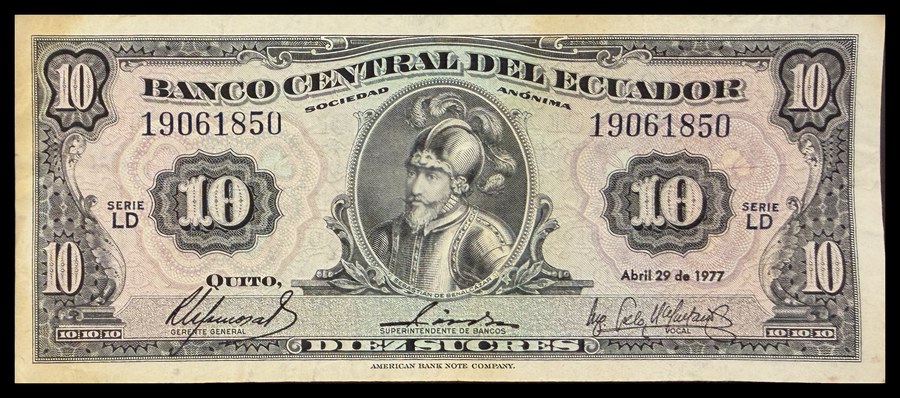
Front: Sebastián de Belalcázar (c. 1480–1551), Spanish conquistador who founded Quito in 1534 and served as its first governor. He played a major role in the Spanish conquest of Ecuador and was instrumental in establishing Spanish rule in the northern Andes. His portrait appears in an oval frame at center, wearing period armor and a plumed helmet, symbolizing his historical significance to Ecuador's colonial foundation.
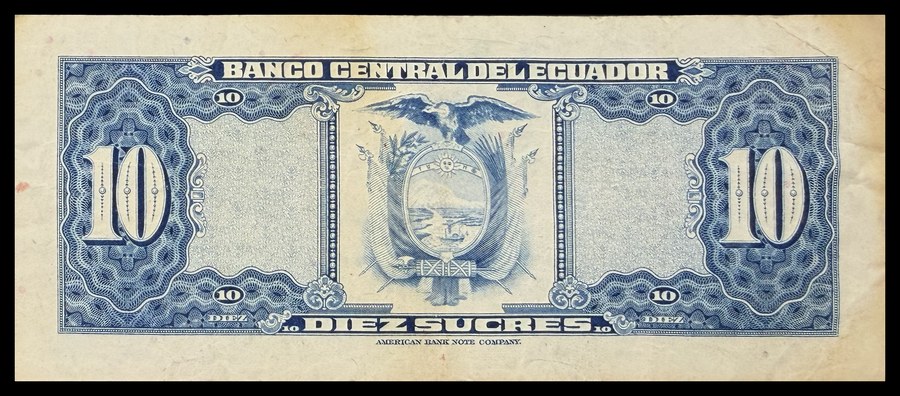
Back: The coat of arms of Ecuador at center, featuring the national shield with Mount Chimborazo, a steamship on the Guayas River, a sun in the upper portion, and four flags representing the four original provinces. The condor perched atop the shield holds a band with the inscription 'ECUADOR'. This design represents Ecuador's geography, independence, and national identity.
How it was made
Signatures: Gerente General: [signature illegible]; Superintendente de Bancos: [signature illegible]; Vocal: [signature illegible]
Security features: microprint,intaglio
Ecuador in South America
Ecuador in South America. Other countries on the same continent shown in muted grey.
Background & history
This note was issued on April 29, 1977 (Serie LD) during Ecuador's use of the Sucre, the national currency from 1884 to 2000. The Sucre was named after Antonio José de Sucre, the independence hero and first president. Ecuador experienced multiple currency reforms and significant inflation during the late 20th century, ultimately replacing the Sucre with the U.S. Dollar in 2000 during a severe economic crisis. The American Bank Note Company printed many Ecuadorian notes during this period.
Collector references
How it came to me
Note shows light circulation with some aging and slight soiling, but retains good detail and structural integrity.
What it's worth now
Valuation history (1)
| date | low | high | currency | source | note |
|---|---|---|---|---|---|
| 2026-05-08 22:59:36 | 5.0 | 15.0 | USD | ai | from claude-sonnet-4-5 |
History & extractions
AI extractions (3)
Edits & decisions (0)
No edits yet.
Manual fixups
Find near-duplicates
Manual pairing override
Edit specimen #170
All fields below post to the same save endpoint. Sections collapse to focus on what you need.
Re-crop manually
Drag the four corners to mark the banknote in each image. Click Save crop to apply.