Collection › France › #187
10 FRF
P-P-84
Needs review
✦ AI 90%
The AI flagged these for your attention. Use ✦ Fact-check to cross-check factual fields against another model's world-knowledge, or 🔍 Re-look at image when you suspect the AI misread the pixels.
-
Part of the note is cut out of the frame.Mark Retake — re-photograph with the whole note in view.
-
Some fields the AI was unsure about — please verify:
- Watermark: “—” (0%)
Click ✦ Ask AI to verify or fix any below. -
The photo is blurry.Mark Retake — re-photograph in better focus.
-
Overall AI confidence is 90% (auto-approve threshold is 92%).Skim the Identity tab; the dots next to each field show what the AI was unsure about.
IMG_6423.jpeg
cropped
IMG_6424.jpeg
cropped

Where & when
What's on the note
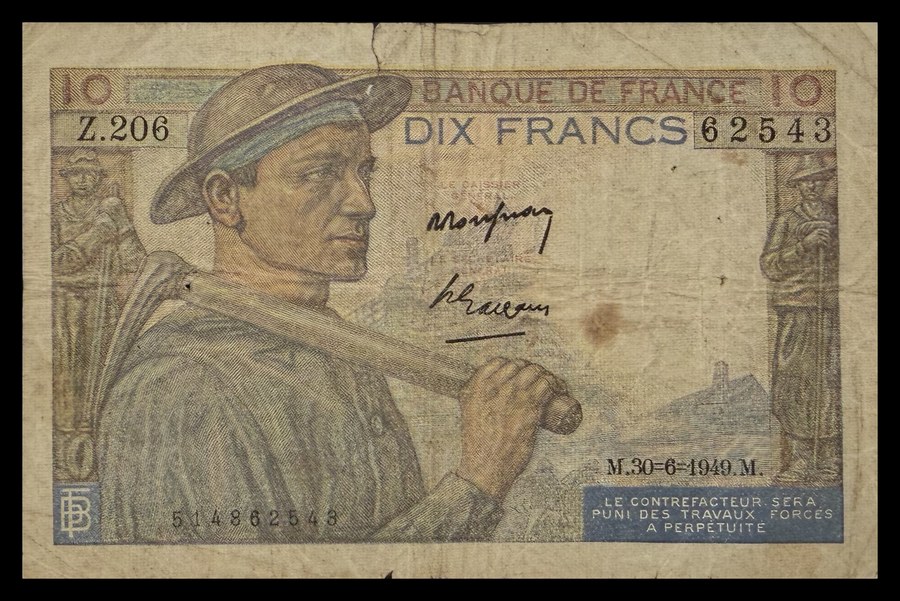
Front: Allegorical miner in work clothes and cap, representing French industrial labor during the early 1940s. The Type Mineur design was issued during World War II and the Vichy period, symbolizing the importance of coal mining to the French economy. The note bears two signatures (Marfany and Rousseau) and includes the legal warning 'LE CONTREFACTEUR SERA PUNI DES TRAVAUX FORCÉS A PERPÉTUITÉ' (counterfeiters will be punished by forced labor for life), reflecting the severity of wartime economic controls.
Back: Young woman in peasant dress holding a sickle and sheaf of wheat, representing French agriculture and rural life. The pastoral imagery balances the industrial theme of the obverse, embodying the dual pillars of the French economy during the wartime and immediate postwar period. Decorative wheat motifs frame the composition.
How it was made
Signatures: Marfany; Rousseau
Security features: intaglio
France in Europe
France in Europe. Other countries on the same continent shown in muted grey.
Background & history
The Type Mineur series was issued by the Banque de France beginning in 1941, during the German occupation and Vichy government period of World War II. The 10 francs denomination of this series remained in production through 1949. These notes circulated during a period of economic hardship, inflation, and rationing. The design emphasizes traditional French values of labor and agriculture. The series was eventually replaced by the nouveau franc in 1960, with old francs demonetized in 1963.
Collector references
How it came to me
Significant circulation wear, center fold tear extending from top edge, staining, and edge tears. Paper remains intact but shows heavy use.
What it's worth now
Valuation history (1)
| date | low | high | currency | source | note |
|---|---|---|---|---|---|
| 2026-05-08 23:00:39 | 5.0 | 15.0 | USD | ai | from claude-sonnet-4-5 |
History & extractions
AI extractions (4)
Edits & decisions (1)
Manual fixups
Find near-duplicates
Manual pairing override
Edit specimen #187
All fields below post to the same save endpoint. Sections collapse to focus on what you need.
Re-crop manually
Drag the four corners to mark the banknote in each image. Click Save crop to apply.