Collection › France › #189
20 FRF
P-100
AI extracted
✦ AI 92%
The AI flagged these for your attention. Use ✦ Fact-check to cross-check factual fields against another model's world-knowledge, or 🔍 Re-look at image when you suspect the AI misread the pixels.
-
Some fields the AI was unsure about — please verify:
- Series year: “—” (0%)
- Issue year: “—” (0%)
- Printer: “—” (0%)
- Watermark: “—” (0%)
Click ✦ Ask AI to verify or fix any below.
IMG_6427.jpeg
cropped
IMG_6428.jpeg
cropped
Where & when
What's on the note
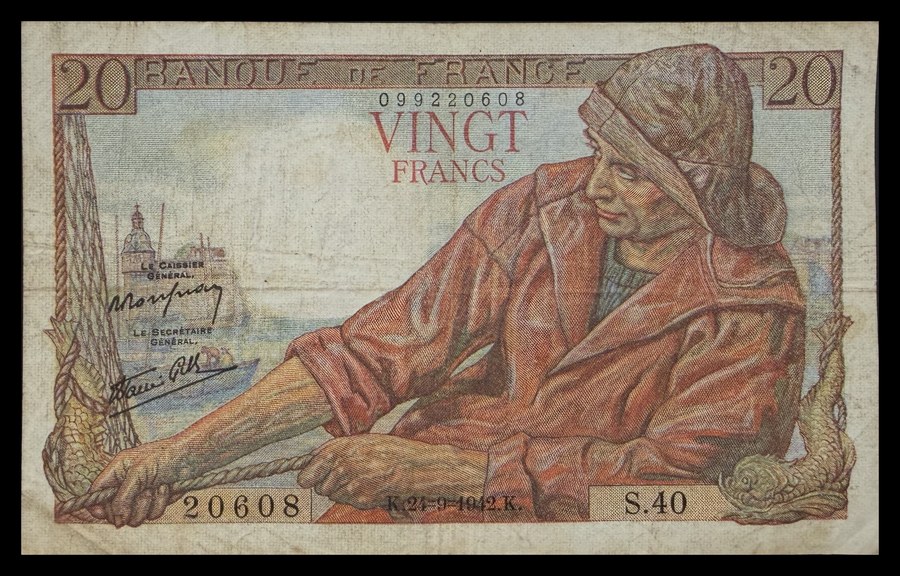
Front: Allegorical scene depicting a French fisherman in traditional working clothes, seated with fishing net and maritime implements. This design represents France's fishing industry and coastal communities during the post-war period. The fisherman motif became iconic of this series, symbolizing honest labor and France's maritime heritage during the reconstruction years following World War II.
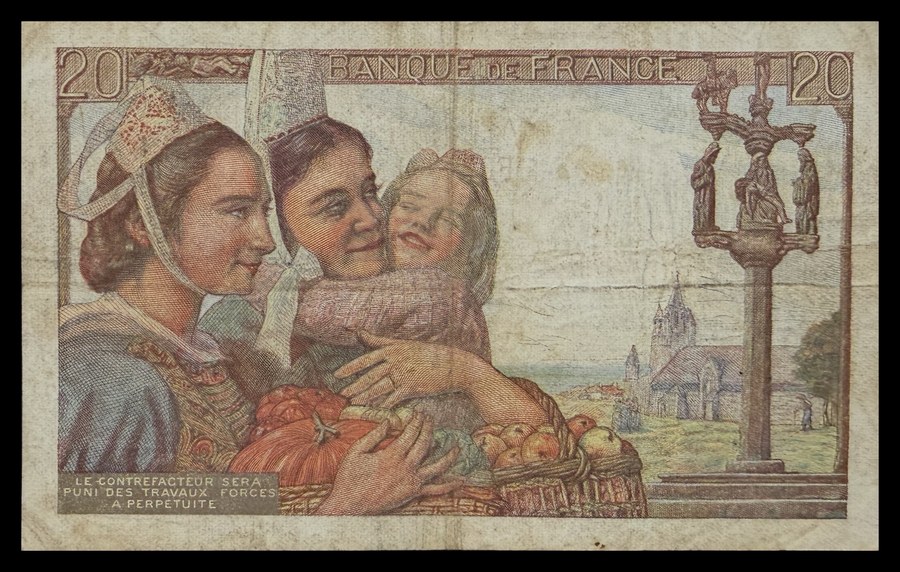
Back: A fisherman's family group showing women and child with basket of produce, alongside a decorative street lamp and a view of a coastal church or chapel in the background. The scene celebrates family life and the prosperity of France's fishing communities, with the inscription 'LE CONTREFACTEUR SERA PUNI DES TRAVAUX FORCÉS A PERPETUITÉ' (counterfeiters will be punished with forced labor for life) as a security warning.
How it was made
Signatures: Caissier Général: Morjane; Le Secrétaire Général: Bouceret
Security features: intaglio,microprint
France in Europe
France in Europe. Other countries on the same continent shown in muted grey.
Background & history
The 'Pêcheur' (Fisherman) series was issued by the Banque de France from 1942 to 1950, spanning the late Vichy period, Liberation, and early Fourth Republic. This 20 francs note was one of the most common denominations in circulation during France's post-war recovery. The series was withdrawn from circulation in 1963 following the 1960 currency reform that introduced the Nouveau Franc at a rate of 100 old francs to 1 new franc. These notes are widely available to collectors today.
Collector references
How it came to me
Note shows significant circulation with multiple folds, creases, and soiling. Paper remains intact with no tears visible. Typical wear for a heavily circulated post-war French note.
What it's worth now
Valuation history (1)
| date | low | high | currency | source | note |
|---|---|---|---|---|---|
| 2026-05-08 17:14:44 | 5.0 | 15.0 | USD | ai | from claude-sonnet-4-5 |
History & extractions
AI extractions (1)
Edits & decisions (0)
No edits yet.
Manual fixups
Find near-duplicates
Manual pairing override
Edit specimen #189
All fields below post to the same save endpoint. Sections collapse to focus on what you need.
Re-crop manually
Drag the four corners to mark the banknote in each image. Click Save crop to apply.