Collection › France › #190
5 FRF
P-P-98a
Needs review
✦ AI 90%
The AI flagged these for your attention. Use ✦ Fact-check to cross-check factual fields against another model's world-knowledge, or 🔍 Re-look at image when you suspect the AI misread the pixels.
-
The photo is blurry.Mark Retake — re-photograph in better focus.
-
Some fields the AI was unsure about — please verify:
- Watermark: “None” (50%)
Click ✦ Ask AI to verify or fix any below. -
Overall AI confidence is 90% (auto-approve threshold is 92%).Skim the Identity tab; the dots next to each field show what the AI was unsure about.
IMG_6429.jpeg
cropped
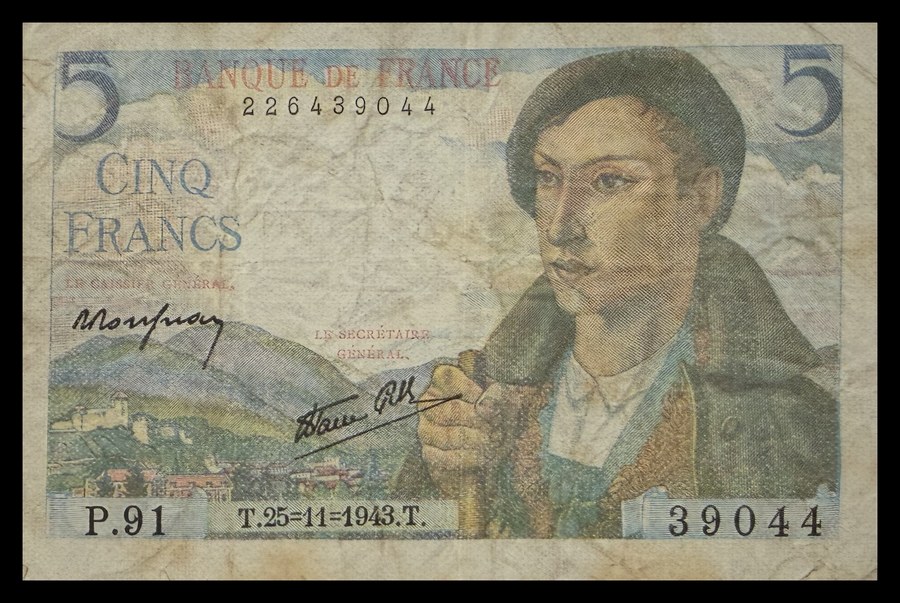
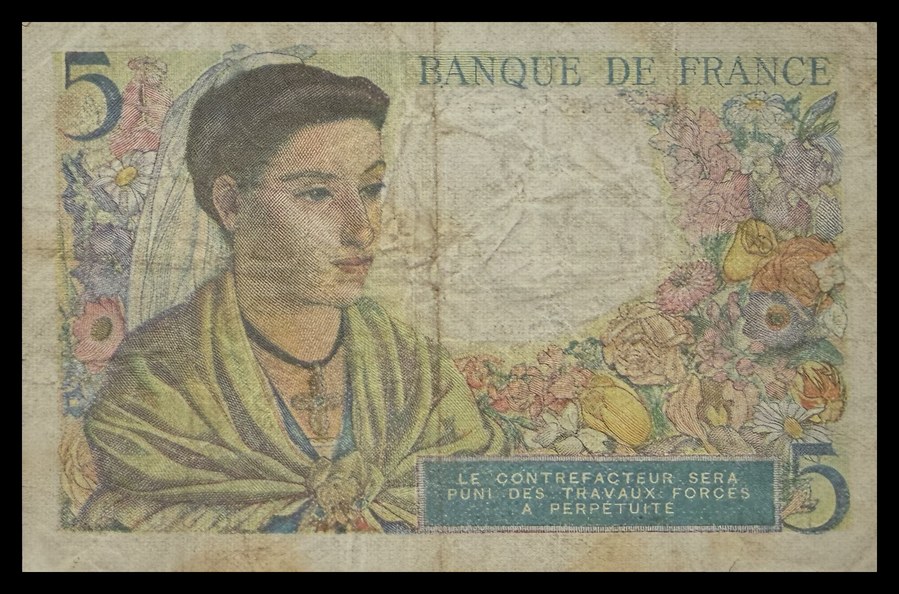
IMG_6430.jpeg
cropped
Where & when
What's on the note
Front: Young shepherd boy depicted in traditional pastoral attire with mountainous rural French landscape in background. This allegorical figure represents France's agricultural heritage and was part of a wartime series emphasizing traditional French values. The 'Berger' (Shepherd) series was issued during the German occupation of France and featured idealized pastoral imagery rather than political figures, reflecting Vichy government aesthetics promoting return to traditional rural life.
Back: Young shepherdess depicted in pastoral dress surrounded by agricultural bounty including wheat sheaves, fruits, and flowers. This allegorical female figure complements the shepherd on the front, symbolizing France's agricultural abundance and traditional rural economy. The text 'LE CONTREFACTEUR SERA PUNI DES TRAVAUX FORCÉS A PERPÉTUITÉ' (The counterfeiter will be punished by forced labor for life) appears as an anti-counterfeiting warning.
How it was made
Signatures: Le Secrétaire Général: Mourgue
Security features: intaglio,microprint
France in Europe
France in Europe. Other countries on the same continent shown in muted grey.
Background & history
The 5 Francs Berger (Shepherd) series was issued by the Banque de France from 1943 to 1947, during and immediately after World War II. Dated 25-11-1943 (November 25, 1943), this note was printed during the German occupation. The series deliberately avoided portraits of political figures, instead using idealized pastoral imagery that aligned with Vichy regime propaganda emphasizing traditional French rural values. The P.91 designation visible on the note refers to the plate number. These notes remained in circulation through the immediate post-war period until the currency reform of 1960 that introduced the Nouveau Franc.
Collector references
How it came to me
Heavily circulated with significant wear, folds, staining, and discoloration throughout. Paper shows thinning and edge damage. Signatures and serial numbers remain legible.
What it's worth now
Valuation history (1)
| date | low | high | currency | source | note |
|---|---|---|---|---|---|
| 2026-05-08 17:14:44 | 3.0 | 8.0 | USD | ai | from claude-sonnet-4-5 |
History & extractions
AI extractions (3)
Edits & decisions (0)
No edits yet.
Manual fixups
Find near-duplicates
Manual pairing override
Edit specimen #190
All fields below post to the same save endpoint. Sections collapse to focus on what you need.
Re-crop manually
Drag the four corners to mark the banknote in each image. Click Save crop to apply.