Collection › Germany › #219
100 Mark
P-P-42
Needs review
✦ AI 95%
The AI flagged these for your attention. Use ✦ Fact-check to cross-check factual fields against another model's world-knowledge, or 🔍 Re-look at image when you suspect the AI misread the pixels.
-
The photo is blurry.Mark Retake — re-photograph in better focus.
IMG_6487.jpeg
cropped
IMG_6488.jpeg
cropped
Where & when
What's on the note
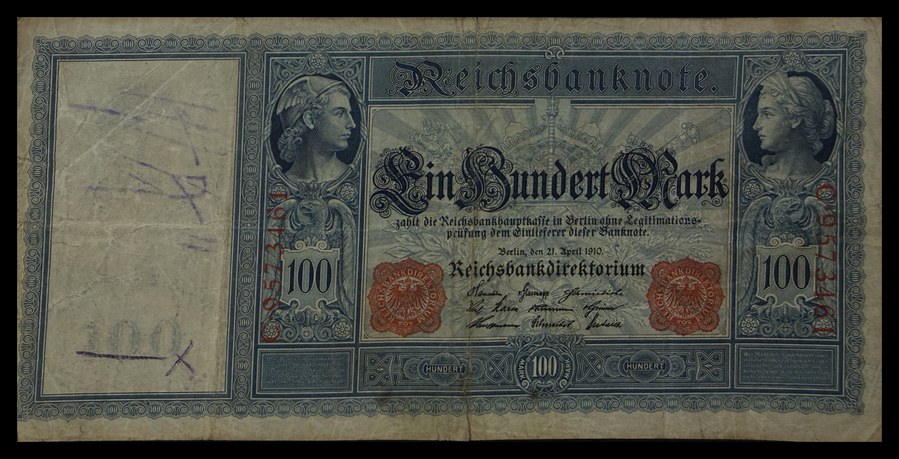
Front: Germania, the allegorical female personification of Germany, appears in profile busts on both sides of the center text. These classical representations symbolized the German Empire during the Imperial period. The note is inscribed 'Reichsbanknote' in Gothic script and dated 'Berlin, den 21. April 1910.' It bears the authority statement that the Reichsbank in Berlin pays the bearer of this note without legitimation check. Two red seals of the Reichsbank appear flanking the denomination and signatures of the Reichsbankdirektorium.
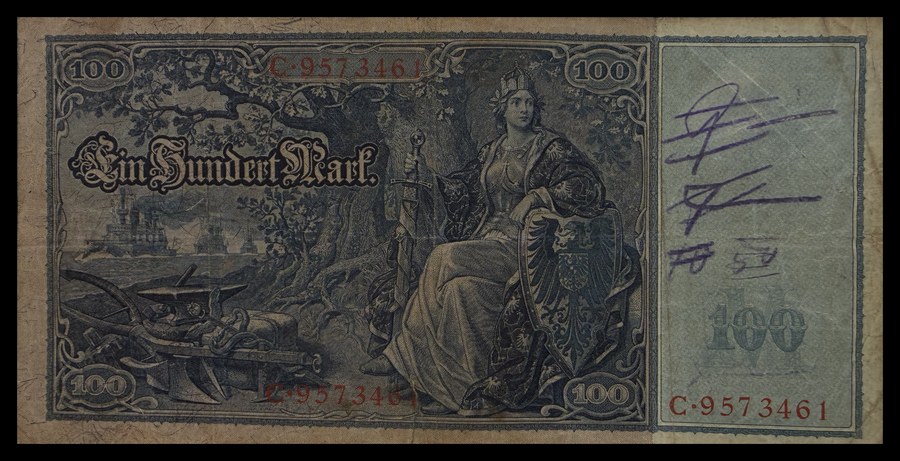
Back: Germania seated in classical robes holding a sword and leaning against a shield bearing the German Imperial eagle. The scene includes allegorical elements of German industry and commerce, with a ship visible in the background on the left representing maritime trade. The ornate design features elaborate scrollwork and the denomination '100' repeated in the corners. This imagery reinforced German imperial power and economic strength during the Kaiserreich period.
How it was made
Signatures: Reichsbankdirektorium members (illegible)
Security features: microprint,intaglio,raised_print
Germany in Europe
Germany in Europe. Other countries on the same continent shown in muted grey.
Background & history
This 100 Mark note belongs to the Reichsbanknote series issued by the German Empire's central bank (Reichsbank) between 1908 and 1914. These notes circulated during the final years of the Kaiserreich under Wilhelm II. The 1910 series featured elaborate engraved designs with allegorical representations of Germania, typical of Imperial German banknote aesthetics. Following World War I and the hyperinflation crisis of 1923, these notes were demonetized and replaced by the Rentenmark in 1924. The Gothic script ('Fraktur') and classical imagery reflect the cultural preferences of Imperial Germany.
Collector references
How it came to me
Note shows circulation with visible folds, ink marks/stamps, and general handling wear. Paper remains intact with no tears visible.
What it's worth now
Valuation history (1)
| date | low | high | currency | source | note |
|---|---|---|---|---|---|
| 2026-05-08 17:21:01 | 15.0 | 40.0 | USD | ai | from claude-sonnet-4-5 |
History & extractions
AI extractions (3)
Edits & decisions (0)
No edits yet.
Manual fixups
Find near-duplicates
Manual pairing override
Edit specimen #219
All fields below post to the same save endpoint. Sections collapse to focus on what you need.
Re-crop manually
Drag the four corners to mark the banknote in each image. Click Save crop to apply.