Collection › Germany › #220
100 Mark Papiermark
P-P-69
Needs review
✦ AI 90%
The AI flagged these for your attention. Use ✦ Fact-check to cross-check factual fields against another model's world-knowledge, or 🔍 Re-look at image when you suspect the AI misread the pixels.
-
Some fields the AI was unsure about — please verify:
- Serial number: “—” (0%)
Click ✦ Ask AI to verify or fix any below. -
The photo is blurry.Mark Retake — re-photograph in better focus.
-
Overall AI confidence is 90% (auto-approve threshold is 92%).Skim the Identity tab; the dots next to each field show what the AI was unsure about.
IMG_6489.jpeg
cropped
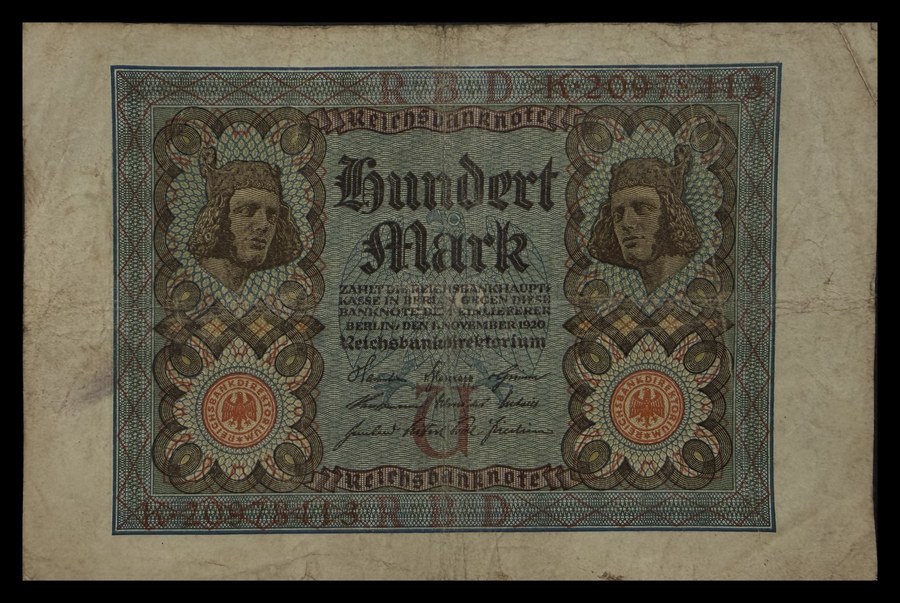
IMG_6490.jpeg
cropped
Where & when
What's on the note
Front: Two allegorical female figures representing Germania appear in ornate frames on either side of the denomination. The text 'Hundert Mark' is prominently displayed in Gothic blackletter script in the center, with issuing text below reading 'ZAHLE ICH GEGEN DIESE BANKNOTE HUNDERT MARK REICHSKASSENSCHEIN' and dated 'BERLIN, DEN 1. NOVEMBER 1920'. The Reichsadler (Imperial Eagle) appears in red circular seals at lower left and right. This design is characteristic of the Weimar Republic hyperinflationary period when the Papiermark was rapidly losing value.
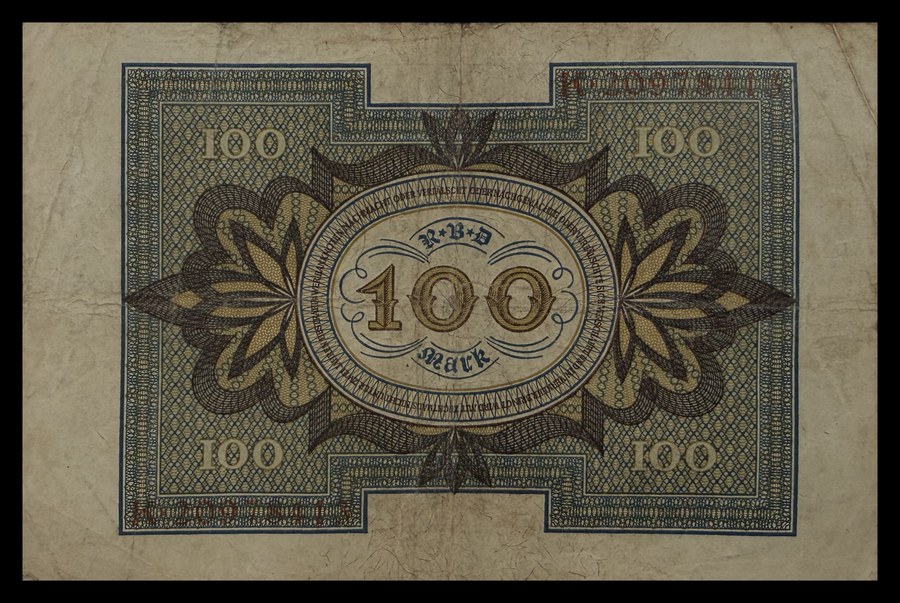
Back: Central oval medallion containing the denomination '100' with 'Mark' below, surrounded by ornamental oak leaf wreaths and geometric guilloche patterns. The denomination '100' appears in each corner. Oak leaves were a traditional German symbol representing strength and endurance, commonly used on currency of this period.
How it was made
Security features: microprint,intaglio
Germany in Europe
Germany in Europe. Other countries on the same continent shown in muted grey.
Background & history
This 100 Mark note belongs to the Reichsbanknote series issued during the early Weimar Republic period, printed on November 1, 1920. This was the beginning phase of the catastrophic hyperinflation that would devastate the German economy from 1921-1923. The Papiermark, which had been introduced in 1914 to replace the pre-war Goldmark, rapidly depreciated during and after World War I. By 1923, the currency had become virtually worthless, with trillion-mark notes being issued. The Papiermark was finally replaced by the Rentenmark in November 1923 at a rate of 1 trillion Papiermark to 1 Rentenmark, ending the hyperinflation. The Reichsdruckerei (Reich Printing Office) in Berlin produced these notes in massive quantities during this period.
Collector references
How it came to me
Note shows significant circulation wear with creases, aging, and some soiling. Paper appears intact but worn.
What it's worth now
Valuation history (1)
| date | low | high | currency | source | note |
|---|---|---|---|---|---|
| 2026-05-08 17:21:00 | 3.0 | 8.0 | USD | ai | from claude-sonnet-4-5 |
History & extractions
AI extractions (3)
Edits & decisions (0)
No edits yet.
Manual fixups
Find near-duplicates
Manual pairing override
Edit specimen #220
All fields below post to the same save endpoint. Sections collapse to focus on what you need.
Re-crop manually
Drag the four corners to mark the banknote in each image. Click Save crop to apply.