Collection › Germany › #221
500 Mark Papiermark
P-P-74b
Needs review
✦ AI 92%
The AI flagged these for your attention. Use ✦ Fact-check to cross-check factual fields against another model's world-knowledge, or 🔍 Re-look at image when you suspect the AI misread the pixels.
-
Some fields the AI was unsure about — please verify:
- Watermark: “—” (0%)
- Front portrait: “—” (0%)
- Reverse subject: “—” (0%)
Click ✦ Ask AI to verify or fix any below. -
The photo is blurry.Mark Retake — re-photograph in better focus.
IMG_6491.jpeg
cropped
IMG_6492.jpeg
cropped
Where & when
What's on the note
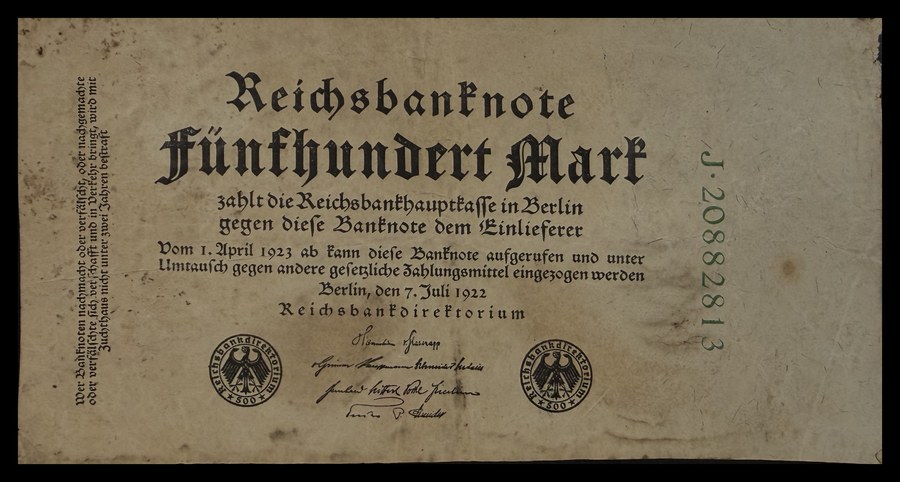
Front: Reichsbanknote 500 Mark from the hyperinflationary period of Weimar Germany, dated 7 July 1922. The note features the Reichsadler (Imperial Eagle) seal of the Reichsbank in two roundels flanking four signatures representing the Reichsbankdirektorium. The Gothic Fraktur text states that the Reichshauptkasse in Berlin pays the bearer and that from 1 April 1923 the note can be recalled and exchanged for other legal tender. This simple design reflects the emergency mass production of currency during the accelerating hyperinflation that would ultimately destroy the Papiermark.
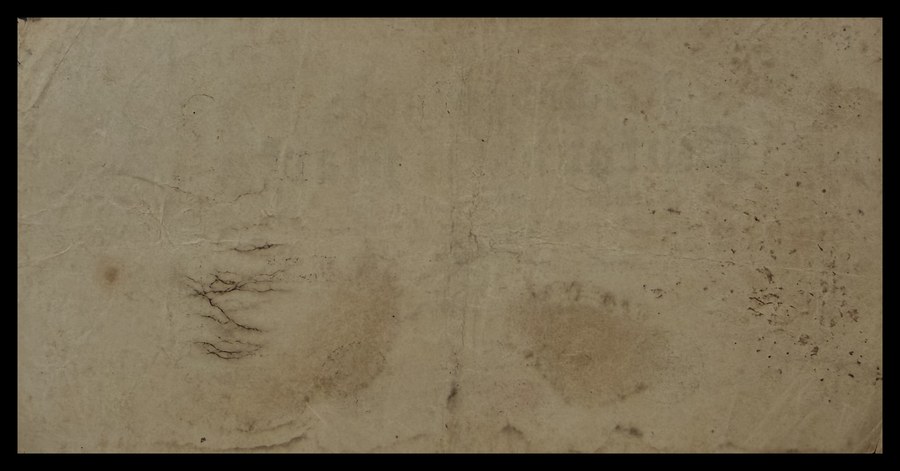
Back: Plain reverse with no printed design, showing only the paper substrate with visible aging, staining, and wear. The blank back was a cost-saving measure during the hyperinflationary crisis when the Reichsbank was printing billions of marks daily to meet demand.
How it was made
Signatures: Reichsbankdirektorium signatures: Havenstein, Luther, Schacht, von Glasenapp
Germany in Europe
Germany in Europe. Other countries on the same continent shown in muted grey.
Background & history
This 500 Mark note belongs to the Reichsbanknote series issued during the Weimar Republic's catastrophic hyperinflation of 1922-1923. Dated 7 July 1922, it was printed during the accelerating phase of the crisis when the Mark was rapidly losing value against foreign currencies. By late 1923, trillion-mark notes would be issued. The inscription regarding recall from 1 April 1923 reflects attempts to manage the currency chaos. The hyperinflation was finally ended in November 1923 with the introduction of the Rentenmark at a rate of 1 Rentenmark = 1 trillion Papiermark. These notes are historically significant as tangible evidence of one of history's most severe monetary collapses, but remain relatively common due to the enormous quantities printed.
Collector references
How it came to me
Note shows moderate circulation with staining, edge wear, and creasing. Paper has aged to tan/brown color typical of hyperinflation-era German notes.
What it's worth now
Valuation history (1)
| date | low | high | currency | source | note |
|---|---|---|---|---|---|
| 2026-05-08 17:21:00 | 2.0 | 10.0 | USD | ai | from claude-sonnet-4-5 |
History & extractions
AI extractions (3)
Edits & decisions (0)
No edits yet.
Manual fixups
Find near-duplicates
Manual pairing override
Edit specimen #221
All fields below post to the same save endpoint. Sections collapse to focus on what you need.
Re-crop manually
Drag the four corners to mark the banknote in each image. Click Save crop to apply.