Collection › Germany › #231
75 Pfennig Mark
The AI flagged these for your attention. Use ✦ Fact-check to cross-check factual fields against another model's world-knowledge, or 🔍 Re-look at image when you suspect the AI misread the pixels.
-
Some fields the AI was unsure about — please verify:
- Dimensions (mm): “—” (0%)
- Pick #: “—” (0%)
Click ✦ Ask AI to verify or fix any below.
IMG_6511.jpeg
cropped
IMG_6512.jpeg
cropped
Where & when
What's on the note
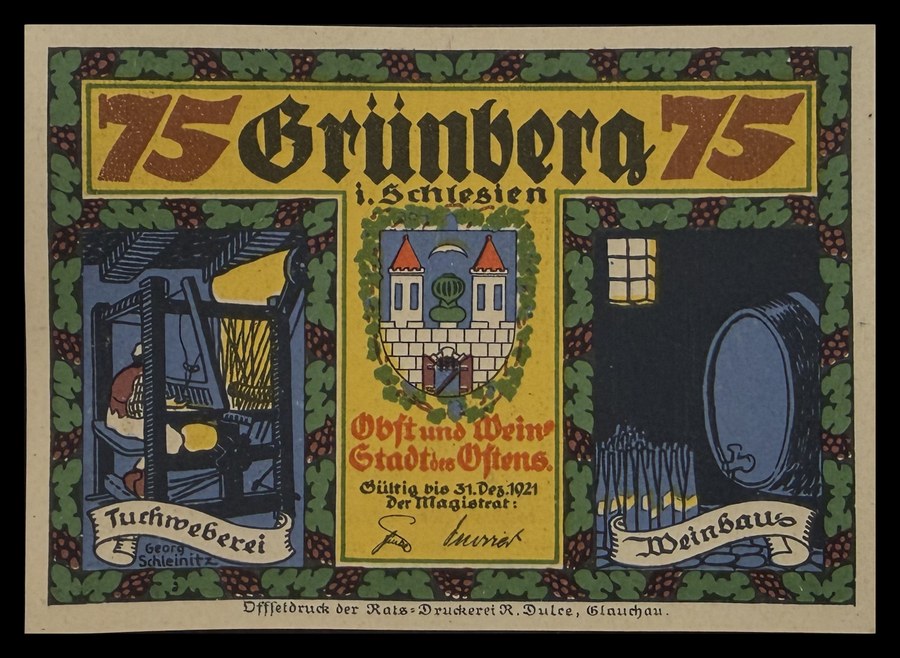
Front: Notgeld issued by Grünberg in Schlesien (now Zielona Góra, Poland), a city historically known for its viticulture and textile production. The central coat of arms displays the city's emblems with two towers and a decorative urn, surrounded by grapevine borders symbolizing the region's wine industry. The left panel depicts a weaving loom labeled 'Tuchweberei' (cloth weaving) representing textile merchant Georg Schilling, while the right panel shows a wine barrel labeled 'Weinbaus' (wine house). The inscription 'Obst und Wein-Stadt des Ostens' identifies Grünberg as the 'Fruit and Wine City of the East'. Valid until December 31, 1921, per magistrate decree, signed by Bürgermeister Mundt.
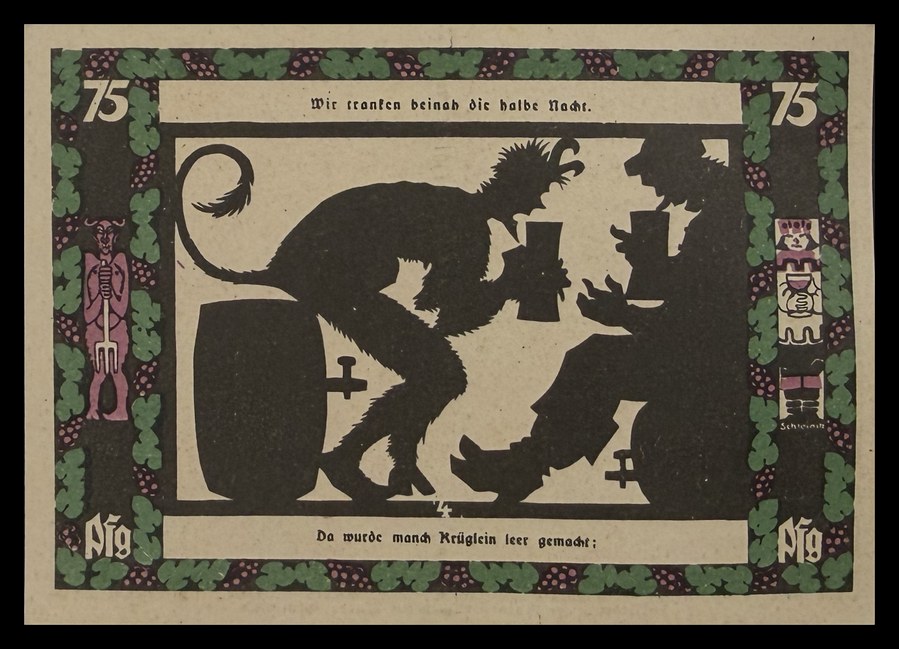
Back: Silhouette scene depicting a devil or demon figure emptying a large wine barrel, with the inscription 'Wir tranken beinah die halbe Nacht' (We drank almost half the night) at top and 'Da wurde manch Krüglein leer gemacht' (Many a jug was emptied) at bottom. The humorous vignette references local wine culture and drinking traditions. Decorative grapevine borders frame the design, with 'Pfg' (Pfennig) marked vertically on both sides. The folk-art style is typical of commemorative German Notgeld issued during the hyperinflation period.
How it was made
Signatures: Bürgermeister: Mundt
Germany in Europe
Germany in Europe. Other countries on the same continent shown in muted grey.
Background & history
🎉 Commemorating Fruit and wine city of Grünberg.
This is German municipal emergency currency (Notgeld) issued by Grünberg in Schlesien during the post-WWI economic crisis and early Weimar hyperinflation. Grünberg (modern Zielona Góra, Poland) was a major wine-producing center in Silesia until 1945. These decorative Notgeld pieces were issued by municipalities when the central government could not supply sufficient small-denomination coinage. The 75 Pfennig denomination was common for Notgeld. This series celebrates local industries—particularly viticulture and textile manufacturing—with Georg Schilling being a notable local textile merchant. The artistic designs made these notes collectible even during their period of validity. Most Notgeld was demonetized by 1923 with the introduction of the Rentenmark to stabilize the currency.
Collector references
How it came to me
Light handling wear and aging to paper, colors remain vibrant, no tears or major creases
What it's worth now
Valuation history (1)
| date | low | high | currency | source | note |
|---|---|---|---|---|---|
| 2026-05-08 17:22:58 | 8.0 | 25.0 | USD | ai | from claude-sonnet-4-5 |
History & extractions
AI extractions (1)
Edits & decisions (0)
No edits yet.
Manual fixups
Find near-duplicates
Manual pairing override
Edit specimen #231
All fields below post to the same save endpoint. Sections collapse to focus on what you need.
Re-crop manually
Drag the four corners to mark the banknote in each image. Click Save crop to apply.