Collection › Germany › #232
10 Pfennig Papiermark
The AI flagged these for your attention. Use ✦ Fact-check to cross-check factual fields against another model's world-knowledge, or 🔍 Re-look at image when you suspect the AI misread the pixels.
-
Some fields the AI was unsure about — please verify:
- Printer: “—” (0%)
- Dimensions (mm): “—” (0%)
- Watermark: “—” (0%)
- Front portrait: “—” (0%)
- Pick #: “—” (0%)
- Serial number: “—” (0%)
Click ✦ Ask AI to verify or fix any below. -
Lighting is too dim for confident reading.Mark Retake — re-photograph with more light.
-
Overall AI confidence is 90% (auto-approve threshold is 92%).Skim the Identity tab; the dots next to each field show what the AI was unsure about.
IMG_6513.jpeg
cropped
IMG_6514.jpeg
cropped
Where & when
What's on the note
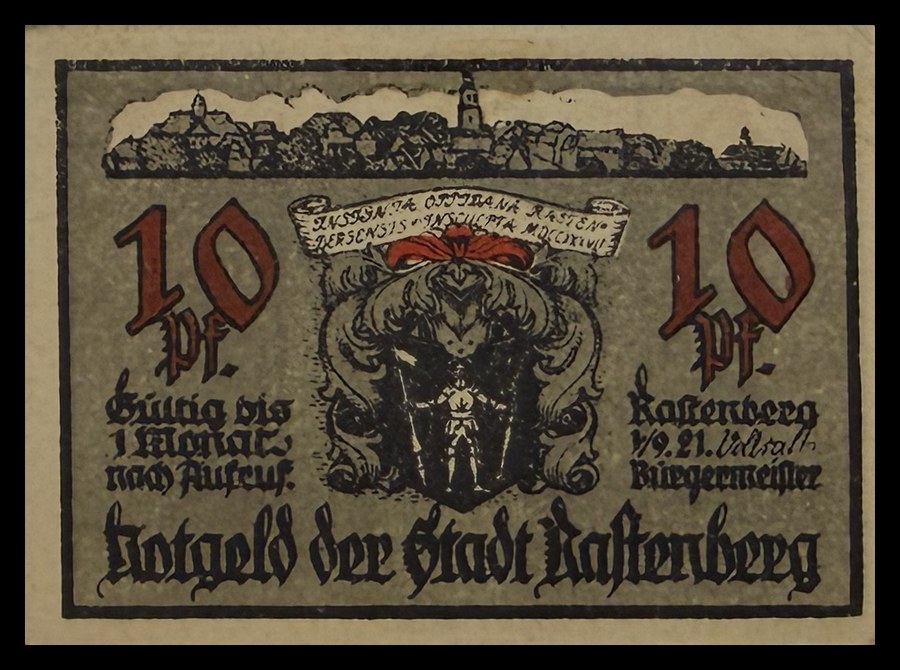
Front: The municipal coat of arms of Rastenberg, Thuringia, featuring a crowned shield with ornate baroque flourishes. The shield depicts a town gate with a crab (cancer/Krabbe) above it, representing the town's name etymology and heraldic device. The banner above reads text identifying the issuing authority. The town silhouette at top shows Rastenberg's skyline with church spire and buildings. Gothic blackletter text at bottom reads 'Notgeld der Stadt Rastenberg' (Emergency money of the City of Rastenberg) with validity dates.
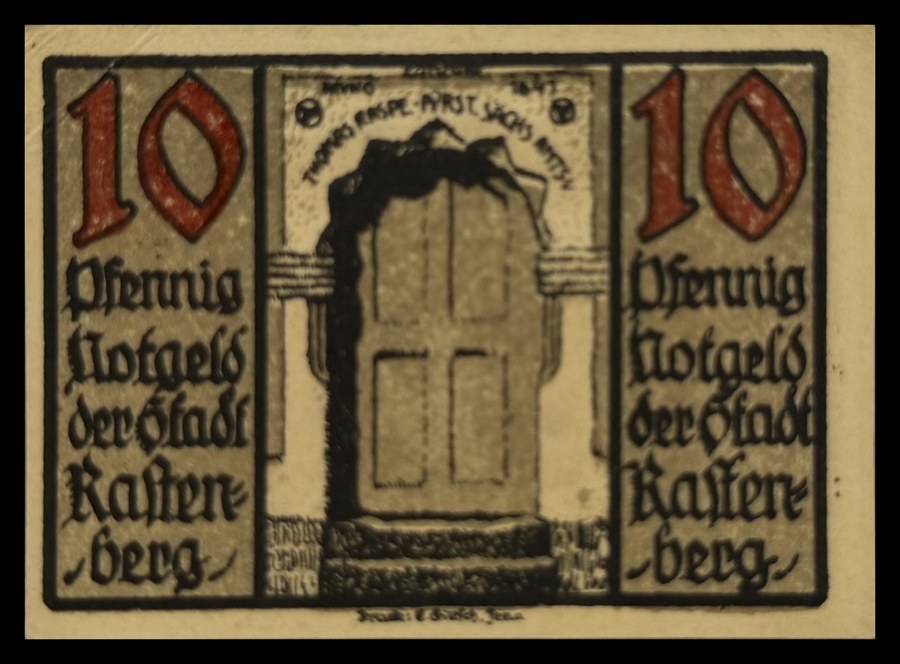
Back: The reverse displays the municipal coat of arms of Rastenberg in simplified form, showing a town gate with a crab above it within a shield. The gate is depicted in silhouette with classical columns on either side. Text 'Pfennig Notgeld der Stadt Rastenberg' (Pfennig emergency money of the City of Rastenberg) frames the design on both sides. The crab is a heraldic reference to the town's name.
How it was made
Germany in Europe
Germany in Europe. Other countries on the same continent shown in muted grey.
Background & history
This is a Notgeld (emergency money) note issued by the city of Rastenberg in Thuringia during the early Weimar Republic hyperinflation period. Notgeld was locally issued scrip produced by German municipalities, businesses, and institutions between 1914–1924 due to shortages of official currency. The 1921 issues were among the most common as inflation accelerated. Rastenberg's notes featured the town's distinctive heraldic crab (Krabbe/cancer), which appears in its coat of arms as a play on the town name. These small-denomination notes were typically printed in series with artistic designs celebrating local history and identity. Most Notgeld was demonetized by 1923 when the Rentenmark was introduced to stabilize the currency.
Collector references
How it came to me
Note shows age-appropriate wear and discoloration consistent with century-old paper emergency currency; edges intact, printing clear.
What it's worth now
Valuation history (1)
| date | low | high | currency | source | note |
|---|---|---|---|---|---|
| 2026-05-08 17:22:53 | 2.0 | 8.0 | USD | ai | from claude-sonnet-4-5 |
History & extractions
AI extractions (2)
Edits & decisions (0)
No edits yet.
Manual fixups
Find near-duplicates
Manual pairing override
Edit specimen #232
All fields below post to the same save endpoint. Sections collapse to focus on what you need.
Re-crop manually
Drag the four corners to mark the banknote in each image. Click Save crop to apply.