Collection › Greece › #247
500 GRD
P-P-201
Needs review
✦ AI 92%
The AI flagged these for your attention. Use ✦ Fact-check to cross-check factual fields against another model's world-knowledge, or 🔍 Re-look at image when you suspect the AI misread the pixels.
-
Some fields the AI was unsure about — please verify:
- Issue year: “—” (0%)
Click ✦ Ask AI to verify or fix any below. -
The photo is blurry.Mark Retake — re-photograph in better focus.
IMG_6543.jpeg
cropped
IMG_6544.jpeg
cropped
Where & when
What's on the note
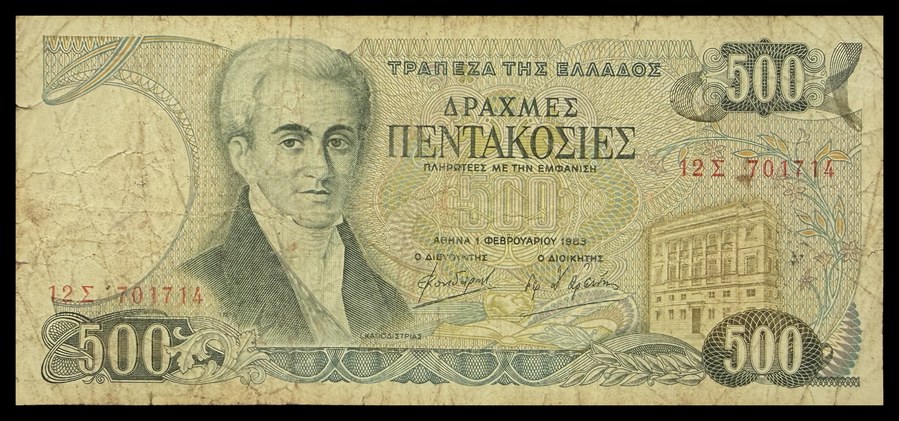
Front: Ioannis Kapodistrias (1776–1831), Greek diplomat, foreign minister of the Russian Empire, and first Governor of independent Greece (1828–1831). He is considered the founder of the modern Greek state and appears on this note alongside an architectural view of a building in Athens. Kapodistrias played a crucial role in Greek independence and state formation before his assassination in 1831. The date 'ΑΘΗΝΑ / ΦΕΒΡΟΥΑΡΙΟΥ 1983' (Athens, February 1983) is printed on the note.
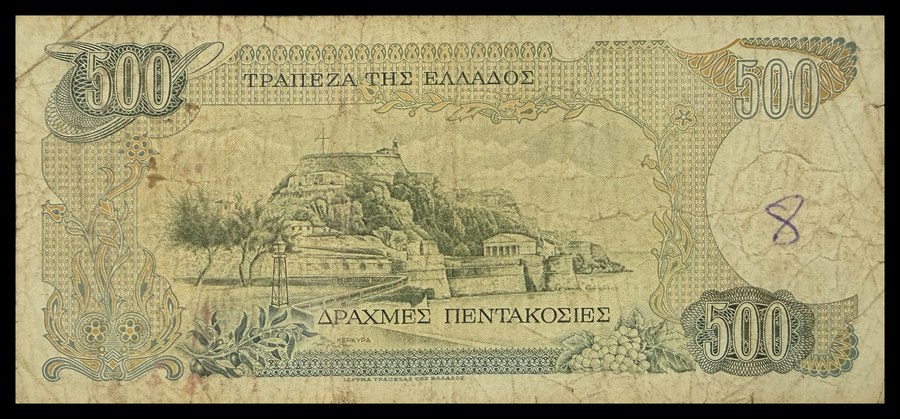
Back: The Old Fortress of Corfu (Palaio Frourio), a Venetian fortress on the island of Corfu built on an ancient acropolis site. The fortress was constructed primarily between the 15th and 16th centuries during Venetian rule to protect against Ottoman attacks. The view shows the fortress on its rocky promontory with the characteristic architecture and defensive walls, symbolizing Greek maritime history and resilience. Decorative olive branches appear at the lower corners.
How it was made
Signatures: Governor: Ιωάννης Μπούρδας (Ioannis Bourdas); unknown second signatory
Security features: watermark,intaglio,microprint
Greece in Europe
Greece in Europe. Other countries on the same continent shown in muted grey.
Background & history
This 500 drachma note is part of the 1983 series issued by the Bank of Greece (Τράπεζα της Ελλάδος). This series remained in circulation throughout the 1980s and 1990s until the adoption of the Euro in 2002. The note honours Ioannis Kapodistrias, a central figure in Greek independence and state-building. The denomination was common during a period of moderate inflation in Greece. All Greek drachma notes were demonetized on February 28, 2002, following Greece's adoption of the Euro on January 1, 2001.
Collector references
How it came to me
Heavily circulated with significant creasing, edge wear, and soiling throughout. Multiple vertical and horizontal folds visible. Paper remains intact but shows extensive handling wear consistent with Fine grade.
What it's worth now
Valuation history (1)
| date | low | high | currency | source | note |
|---|---|---|---|---|---|
| 2026-05-08 17:25:53 | 2.0 | 5.0 | USD | ai | from claude-sonnet-4-5 |
History & extractions
AI extractions (2)
Edits & decisions (0)
No edits yet.
Manual fixups
Find near-duplicates
Manual pairing override
Edit specimen #247
All fields below post to the same save endpoint. Sections collapse to focus on what you need.
Re-crop manually
Drag the four corners to mark the banknote in each image. Click Save crop to apply.