Collection › Greece › #248
1000 GRD
P-P-202a
AI extracted
✦ AI 93%
The AI flagged these for your attention. Use ✦ Fact-check to cross-check factual fields against another model's world-knowledge, or 🔍 Re-look at image when you suspect the AI misread the pixels.
-
Some fields the AI was unsure about — please verify:
- Printer: “—” (0%)
Click ✦ Ask AI to verify or fix any below.
IMG_6545.jpeg
cropped
IMG_6546.jpeg
cropped
Where & when
What's on the note
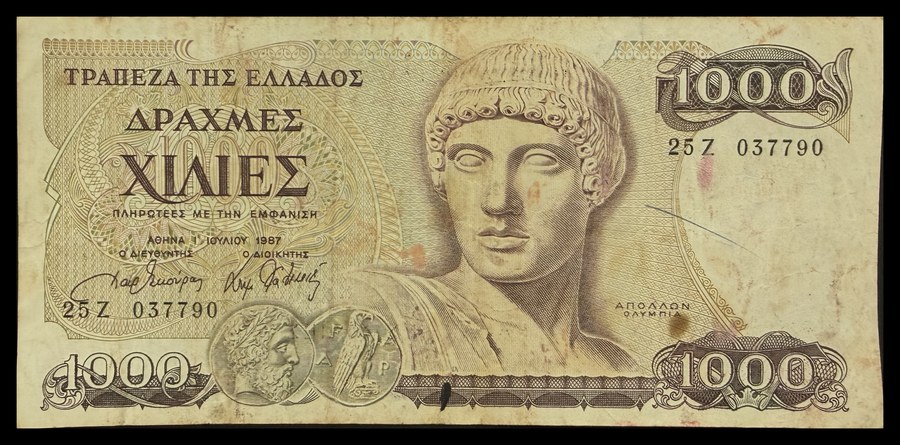
Front: Apollo, the ancient Greek god of light, music, poetry, prophecy, and healing, depicted as the Apollon of Olympia (also known as the Apollo of Olympia). The sculpture dates from approximately 460 BCE and was part of the west pediment of the Temple of Zeus at Olympia. Apollo appears in classical style with idealized features and curled hair, representing one of the most important Olympian deities. The note includes ancient Greek coins at lower left showing classical imagery. The denomination is prominently displayed as 1000 drachmes (ΧΙΛΙΕΣ ΔΡΑΧΜΕΣ), with the text indicating full payment upon presentation (ΠΛΗΡΩΤΕΕΣ ΜΕ ΤΗΝ ΕΜΦΑΝΙΣΗ).
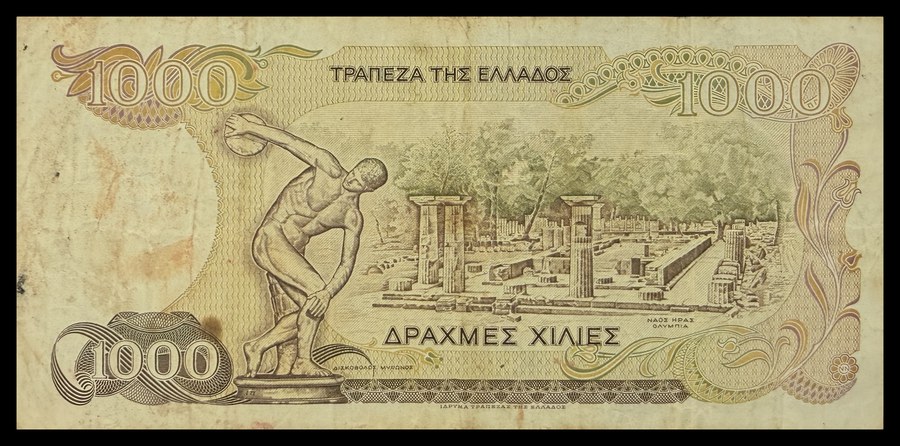
Back: The Temple of Hera at Ancient Olympia, one of the oldest monumental temples in Greece, built around 600 BCE in the Doric order. The site, located in the Peloponnese, was the birthplace of the Olympic Games in 776 BCE and served as the primary sanctuary for the worship of Zeus and Hera. To the left is the famous ancient Greek sculpture Discobolus (Discus Thrower) by Myron (circa 450 BCE), which embodies the classical Greek ideal of athletic perfection and harmony. The combination symbolizes Greece's ancient Olympic heritage and athletic tradition. The text 'ΝΑΟΣ ΗΡΑΣ ΟΛΥΜΠΙΑ' (Temple of Hera, Olympia) identifies the archaeological site.
How it was made
Signatures: Governor: Unknown; Cashier: Unknown
Security features: thread,microprint,intaglio
Greece in Europe
Greece in Europe. Other countries on the same continent shown in muted grey.
Background & history
This 1000 drachma note belongs to the 1987 series issued by the Bank of Greece, which remained in circulation until Greece adopted the Euro on January 1, 2002. The drachma was demonetized on February 28, 2002, after a dual-circulation period. This series emphasized Greece's ancient cultural heritage, featuring classical art and archaeological sites. The design celebrates Greece's position as the cradle of Western civilization and the birthplace of the Olympic Games. The Apollo motif was chosen to represent the pinnacle of classical Greek art and religious iconography.
Collector references
How it came to me
Note shows moderate circulation with visible wear, some staining, and corner softening. The design remains fully legible with intact paper integrity.
What it's worth now
Valuation history (1)
| date | low | high | currency | source | note |
|---|---|---|---|---|---|
| 2026-05-08 17:26:19 | 3.0 | 8.0 | USD | ai | from claude-sonnet-4-5 |
History & extractions
AI extractions (1)
Edits & decisions (0)
No edits yet.
Manual fixups
Find near-duplicates
Manual pairing override
Edit specimen #248
All fields below post to the same save endpoint. Sections collapse to focus on what you need.
Re-crop manually
Drag the four corners to mark the banknote in each image. Click Save crop to apply.