Collection › Greece › #255
500 GRD
P-201
AI extracted
✦ AI 93%
The AI flagged these for your attention. Use ✦ Fact-check to cross-check factual fields against another model's world-knowledge, or 🔍 Re-look at image when you suspect the AI misread the pixels.
-
Some fields the AI was unsure about — please verify:
- Printer: “—” (0%)
Click ✦ Ask AI to verify or fix any below.
IMG_6559.jpeg
cropped
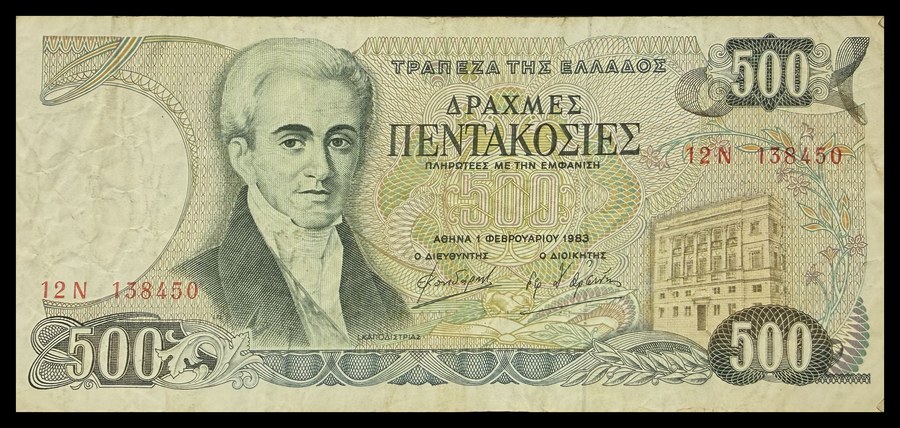
IMG_6560.jpeg
cropped
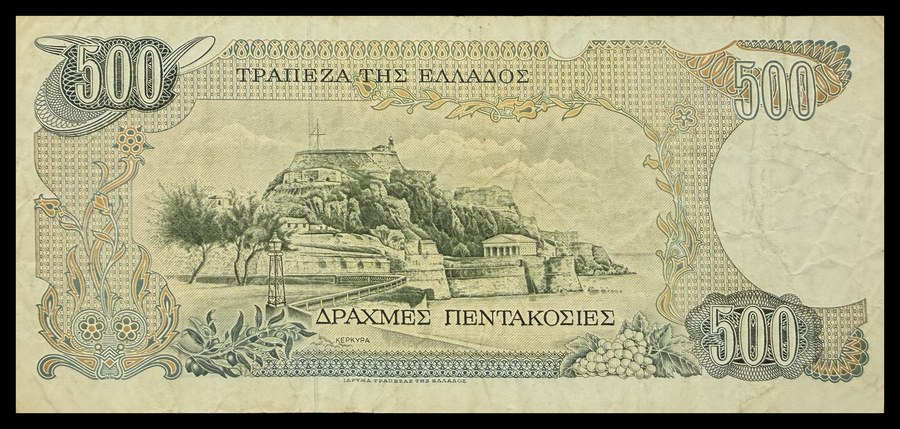
Where & when
What's on the note
Front: Ioannis Kapodistrias (1776–1831), Greek statesman and diplomat who served as the first head of state of independent Greece (1827–1831). A former foreign minister of the Russian Empire, he returned to Greece during the War of Independence and became the first Governor of the newly established Hellenic Republic. His efforts to modernize the Greek state and establish institutions were cut short by his assassination in 1831. He is widely honored as a founder of modern Greece and appears on multiple Greek banknote series.
Back: The Old Fortress of Corfu (Palaio Frourio), a Venetian fortress on the island of Corfu that protected the city from Ottoman invasions. Built on an artificial islet with origins dating to Byzantine times, the fortress was extensively developed by the Venetians between the 15th and 16th centuries. The site includes the distinctive Church of St. George built in the British colonial period. The fortress symbolizes Corfu's strategic importance and its unique history as one of the few Greek territories never conquered by the Ottomans.
How it was made
Signatures: Governor: I. Chalikias; Cashier: V. Rapanos
Security features: watermark,intaglio,microprint,security_thread
Greece in Europe
Greece in Europe. Other countries on the same continent shown in muted grey.
Background & history
This note belongs to the 1983 Issue series of Greek drachma banknotes, issued by the Bank of Greece during the period before Greece's adoption of the euro. The 500 drachma denomination was a mid-range note in circulation during the 1980s. The series featured prominent Greek historical figures and landmarks, with Kapodistrias honored on this denomination for his role in establishing the modern Greek state. Greek drachma notes were withdrawn from circulation on 28 February 2002, when Greece fully transitioned to the euro, though exchange was permitted for a period thereafter.
Collector references
How it came to me
Note shows moderate circulation with some creasing and edge wear; colors remain intact with no major tears or stains.
What it's worth now
Valuation history (1)
| date | low | high | currency | source | note |
|---|---|---|---|---|---|
| 2026-05-08 17:27:55 | 3.0 | 8.0 | USD | ai | from claude-sonnet-4-5 |
History & extractions
AI extractions (1)
Edits & decisions (0)
No edits yet.
Manual fixups
Find near-duplicates
Manual pairing override
Edit specimen #255
All fields below post to the same save endpoint. Sections collapse to focus on what you need.
Re-crop manually
Drag the four corners to mark the banknote in each image. Click Save crop to apply.