Collection › Greece › #256
5000 GRD
P-P-119
Needs review
✦ AI 92%
The AI flagged these for your attention. Use ✦ Fact-check to cross-check factual fields against another model's world-knowledge, or 🔍 Re-look at image when you suspect the AI misread the pixels.
-
Some fields the AI was unsure about — please verify:
- Series year: “—” (0%)
- Printer: “—” (0%)
- Dimensions (mm): “—” (0%)
Click ✦ Ask AI to verify or fix any below. -
Auto-crop on the FRONT was uncertain (not a clean rectangle).Use ✂ Re-crop to mark the corners by hand.
IMG_6561.jpeg
uncertain
IMG_6562.jpeg
cropped
Where & when
What's on the note
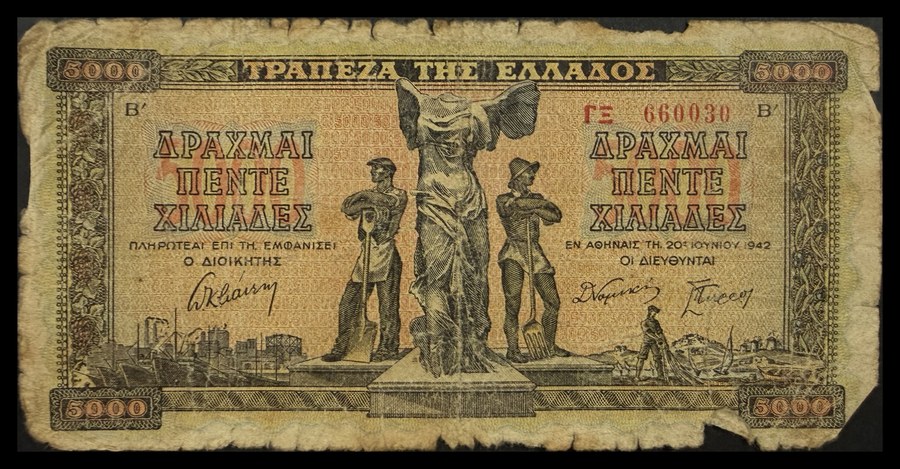
Front: Nike of Samothrace (Winged Victory), the ancient Greek marble sculpture from circa 200–190 BCE now housed in the Louvre Museum. This Hellenistic masterpiece, discovered on the island of Samothrace in 1863, depicts the goddess Nike and is one of the most celebrated works of ancient Greek art. She appears at center flanked by two classical male figures, with industrial vignettes (factory and port scenes) at lower corners representing modern Greek economic activity.
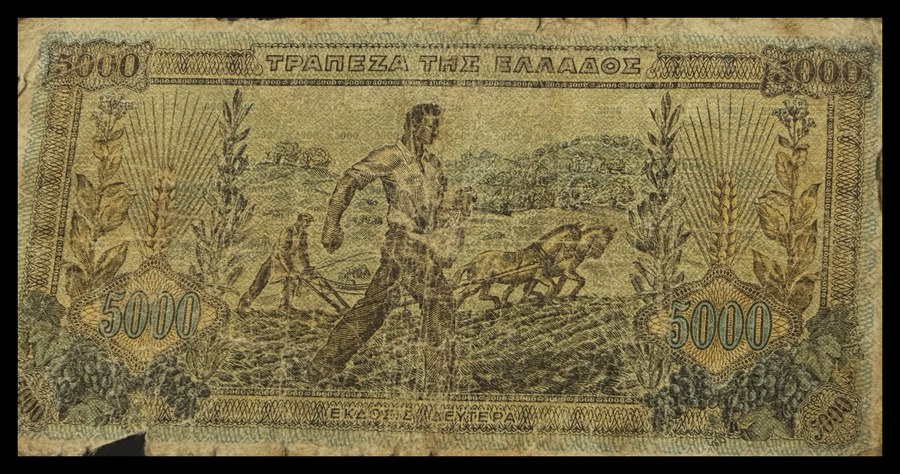
Back: Agricultural scene depicting Greek farmers at work in the fields with oxen-drawn plows, surrounded by sheaves of wheat and agricultural implements. The scene symbolizes Greece's rural economy and agricultural heritage, with decorative plant motifs (wheat sheaves and palm fronds) in the corners emphasizing the theme of productivity and harvest.
How it was made
Signatures: Governor: X. Zolotas; Director: D. N. Nomicos
Security features: intaglio
Greece in Europe
Greece in Europe. Other countries on the same continent shown in muted grey.
Background & history
This 5,000 drachma note was issued by the Bank of Greece during the Axis occupation of Greece in World War II (1942). The date on the note, 20 June 1942 (ΕΝ ΑΘΗΝΑΙΣ ΤΗ 20 ΙΟΥΝΙΟΥ 1942), places it during the period of severe hyperinflation that devastated the Greek economy under occupation. The German and Italian occupiers forced the Bank of Greece to print massive quantities of currency to finance occupation costs, causing the drachma to collapse in value. By 1944, notes reached denominations in the billions. This series was withdrawn and demonetized after liberation in 1944, when Greece introduced currency reforms to stabilize the economy. The juxtaposition of classical Greek imagery (Nike) with modern industrial and agricultural scenes reflects an attempt to maintain national identity and continuity during occupation.
Collector references
How it came to me
Heavy circulation with significant wear, edge tears, staining and discoloration throughout. Multiple creases and folds. Note shows the harsh economic conditions of wartime Greece.
What it's worth now
Valuation history (1)
| date | low | high | currency | source | note |
|---|---|---|---|---|---|
| 2026-05-08 17:27:53 | 5.0 | 15.0 | USD | ai | from claude-sonnet-4-5 |
History & extractions
AI extractions (2)
Edits & decisions (0)
No edits yet.
Manual fixups
Find near-duplicates
Manual pairing override
Edit specimen #256
All fields below post to the same save endpoint. Sections collapse to focus on what you need.
Re-crop manually
Drag the four corners to mark the banknote in each image. Click Save crop to apply.