Collection › Guinea › #260
100 Guinean Franc
P-P-15
AI extracted
✦ AI 93%
The AI flagged these for your attention. Use ✦ Fact-check to cross-check factual fields against another model's world-knowledge, or 🔍 Re-look at image when you suspect the AI misread the pixels.
-
Some fields the AI was unsure about — please verify:
- Printer: “—” (0%)
Click ✦ Ask AI to verify or fix any below.
IMG_6569.jpeg
cropped
IMG_6570.jpeg
cropped
Where & when
What's on the note
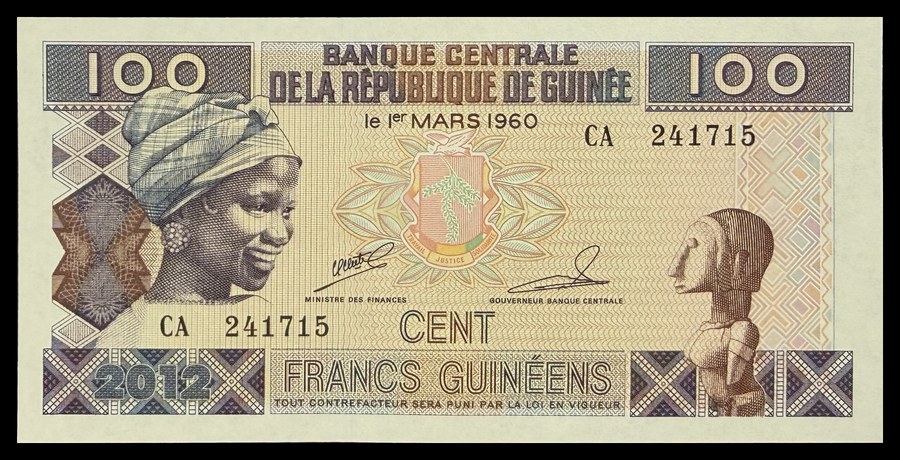
Front: Profile portrait of a Guinean woman wearing traditional headwrap and jewelry, representing the cultural identity of newly independent Guinea. The note features the coat of arms of the Republic of Guinea with the motto 'JUSTICE' on a banner, flanked by olive branches. This first series was issued on March 1, 1960 ('le 1er MARS 1960'), shortly after Guinea became the first French colony in West Africa to vote for independence in 1958, breaking away from the French Community under President Ahmed Sékou Touré. The date '20.12' appears at lower left, and a carved wooden figure appears at right.
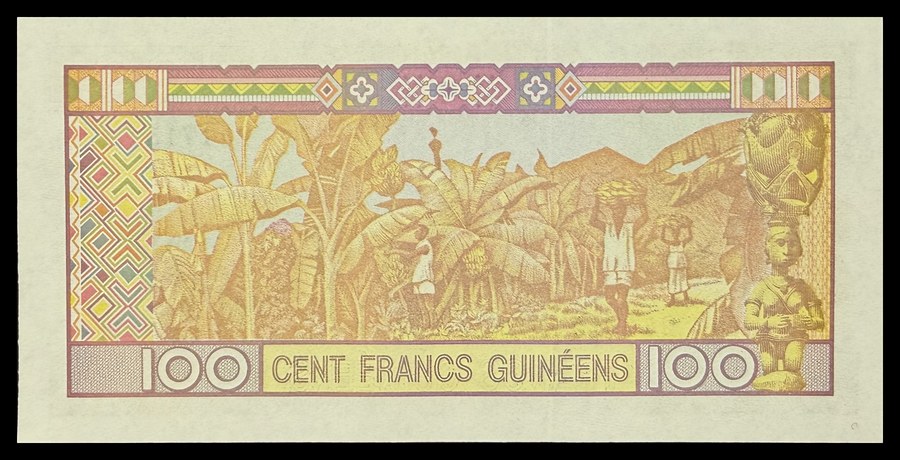
Back: Rural village scene depicting traditional Guinean life with banana trees, palm trees, and thatched-roof huts (cases) set against mountainous terrain in the Fouta Djallon highlands. This pastoral scene emphasizes Guinea's agricultural economy and traditional village life, reflecting the new nation's emphasis on cultural authenticity and rural development. The geometric border patterns draw on traditional West African textile designs.
How it was made
Signatures: Ministre des Finances: [signature]; Gouverneur Banque Centrale: [signature]
Security features: intaglio,microprint,guilloche
Guinea in Africa
Guinea in Africa. Other countries on the same continent shown in muted grey.
Background & history
🎉 Commemorating Independence from France on October 2, 1958.
This note belongs to the first series issued by the Banque Centrale de la République de Guinée following independence. Guinea became independent on October 2, 1958, after voting 'No' in Charles de Gaulle's referendum, making it the only French African colony to reject continued association with France. The Guinean franc was introduced in 1960 to replace the French West African franc at par. This series circulated from 1960 until currency reform in 1971 introduced the Syli at a rate of 1 Syli = 10 Guinean francs. The designs celebrate Guinean cultural identity and agricultural economy, departing from French colonial imagery.
Collector references
How it came to me
Note appears well-preserved with strong colors and clear details, minor handling evident
What it's worth now
Valuation history (1)
| date | low | high | currency | source | note |
|---|---|---|---|---|---|
| 2026-05-08 17:28:54 | 15.0 | 35.0 | USD | ai | from claude-sonnet-4-5 |
History & extractions
AI extractions (1)
Edits & decisions (0)
No edits yet.
Manual fixups
Find near-duplicates
Manual pairing override
Edit specimen #260
All fields below post to the same save endpoint. Sections collapse to focus on what you need.
Re-crop manually
Drag the four corners to mark the banknote in each image. Click Save crop to apply.