Collection › Guinea › #261
100 Guinean Franc
P-P-15
Needs review
✦ AI 88%
The AI flagged these for your attention. Use ✦ Fact-check to cross-check factual fields against another model's world-knowledge, or 🔍 Re-look at image when you suspect the AI misread the pixels.
-
Some fields the AI was unsure about — please verify:
- Printer: “—” (0%)
Click ✦ Ask AI to verify or fix any below. -
Overall AI confidence is 88% (auto-approve threshold is 92%).Skim the Identity tab; the dots next to each field show what the AI was unsure about.
IMG_6571.jpeg
cropped
IMG_6572.jpeg
cropped
Where & when
What's on the note
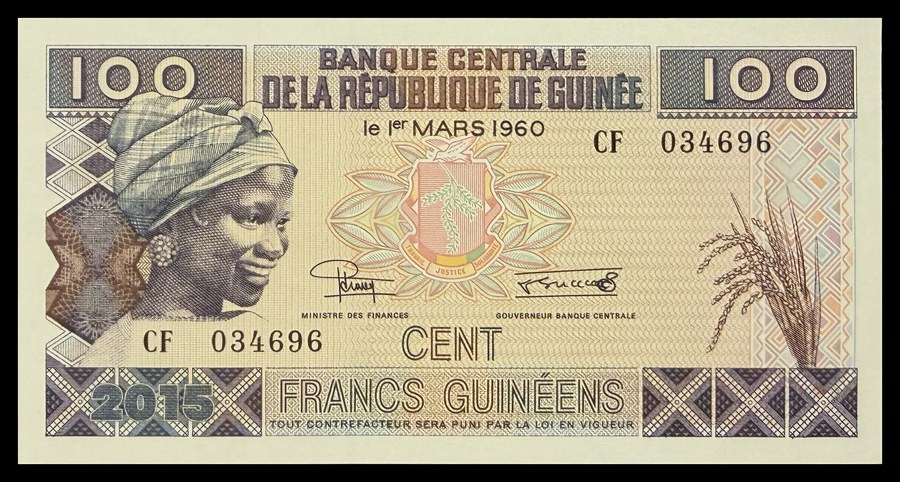
Front: Portrait of a Guinean woman in traditional dress with elaborate headwrap, representing the newly independent nation's cultural identity. Guinea gained independence from France on October 2, 1958, under President Ahmed Sékou Touré, and issued its first national currency in 1960, replacing the French West African franc. The note bears the date 'le 1er MARS 1960' marking the introduction of the Guinean franc. The coat of arms features an elephant with the word 'JUSTICE', symbolizing the republic's ideals. The denomination '100 FRANCS GUINÉENS' appears prominently, with geometric patterns and a rice stalk motif representing agriculture.
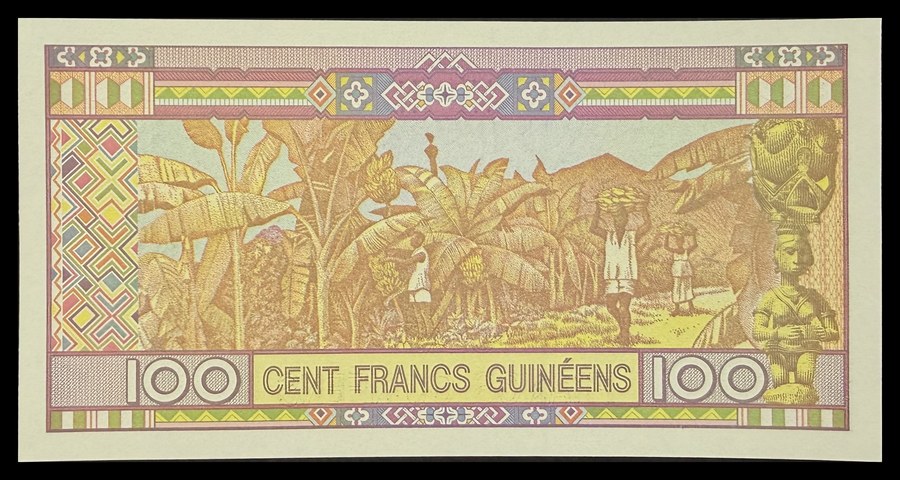
Back: Traditional Guinean village scene with banana trees, palm trees, and conical-roofed huts, depicting rural life and the agricultural foundation of the newly independent nation. The scene represents Guinea's primary economic activities in the early independence period, with tropical vegetation including banana plants prominent in the composition. Decorative borders feature traditional African geometric patterns in multiple colors.
How it was made
Signatures: Ministre des Finances: [signature]; Gouverneur Banque Centrale: [signature]
Security features: intaglio,microprint
Guinea in Africa
Guinea in Africa. Other countries on the same continent shown in muted grey.
Background & history
🎉 Commemorating Independence from France (October 2, 1958).
This note belongs to the first national currency series issued by the Republic of Guinea following independence from France in 1958. The Guinean franc was introduced on March 1, 1960, to replace the French West African franc at par. Under President Ahmed Sékou Touré's government, Guinea pursued an independent economic path, breaking with the French monetary union. This series circulated until 1971, when it was replaced by the Syli at a rate of 10 francs = 1 syli as part of Guinea's adoption of a decimal monetary system. The imagery on these notes emphasized national pride, African cultural identity, and agricultural development themes central to the post-independence nation-building project.
Collector references
How it came to me
Note shows moderate circulation with some creasing and slight discoloration. Colors remain relatively vibrant with good detail visible in the portrait and scene.
What it's worth now
Valuation history (1)
| date | low | high | currency | source | note |
|---|---|---|---|---|---|
| 2026-05-08 17:28:57 | 15.0 | 40.0 | USD | ai | from claude-sonnet-4-5 |
History & extractions
AI extractions (2)
Edits & decisions (0)
No edits yet.
Manual fixups
Find near-duplicates
Manual pairing override
Edit specimen #261
All fields below post to the same save endpoint. Sections collapse to focus on what you need.
Re-crop manually
Drag the four corners to mark the banknote in each image. Click Save crop to apply.