Collection › Austria › #27
50 Schilling
P-P-139
Needs review
✦ AI 90%
The AI flagged these for your attention. Use ✦ Fact-check to cross-check factual fields against another model's world-knowledge, or 🔍 Re-look at image when you suspect the AI misread the pixels.
-
Overall AI confidence is 90% (auto-approve threshold is 92%).Skim the Identity tab; the dots next to each field show what the AI was unsure about.
IMG_6078.HEIC
cropped
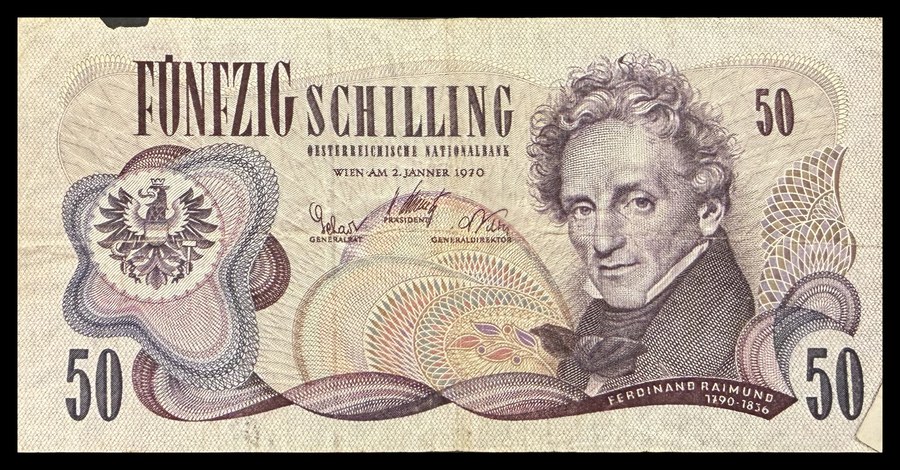
IMG_6079.HEIC
cropped
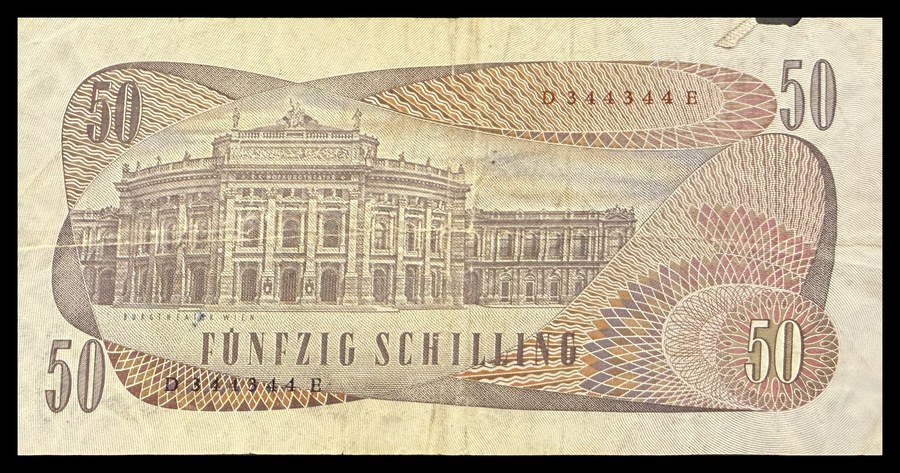
Where & when
What's on the note
Front: Ferdinand Raimund (1790–1836), Austrian actor and playwright who created the Viennese poetic comedy genre known as Zauberposse. He was one of the most prominent figures of the Biedermeier period in Viennese theatre, known for works such as 'Der Alpenkönig und der Menschenfeind' and 'Der Verschwender'. His legacy in Austrian theatrical tradition led to his commemoration on this banknote. The Austrian eagle coat of arms appears at left, with the date 'WIEN AM 2. JÄNNER 1970' and signatures of the Oesterreichische Nationalbank president and general director.
Back: The Burgtheater in Vienna, one of the most important German-language theatres in the world and the Austrian National Theatre. Originally founded in 1741, the current neo-baroque building on the Ringstrasse was designed by Gottfried Semper and Carl Freiherr von Hasenauer, opening in 1888. The theatre is closely associated with Ferdinand Raimund, who performed there during the early 19th century and whose plays remain part of the Austrian theatrical canon.
How it was made
Signatures: Präsident: [illegible]; Generaldirektor: [illegible]
Security features: thread,intaglio,microprint
Austria in Europe
Austria in Europe. Other countries on the same continent shown in muted grey.
Background & history
Third series of Austrian Schilling notes issued 1966–1983 by the Oesterreichische Nationalbank following the Second Republic's currency stabilization. This 50 Schilling note was issued on January 2, 1970, during a period of economic growth in Austria. The series featured prominent Austrian cultural figures, with Raimund representing the nation's theatrical heritage. The Schilling remained Austria's currency until euro adoption on January 1, 2002, with Schilling notes demonetized on February 28, 2002. This series was printed domestically and featured traditional intaglio printing with sophisticated security measures typical of mid-20th century European banknotes.
Collector references
How it came to me
Note appears to have light circulation with minor handling marks but retains good detail and color; minor edge wear visible
What it's worth now
Valuation history (1)
| date | low | high | currency | source | note |
|---|---|---|---|---|---|
| 2026-05-08 08:12:51 | 3.0 | 6.0 | USD | ai | claude-sonnet-4-5: Austria P-139 50 Schilling 1970 is a common issue from a long series; XF examples typically retail for $3-6 based on recent dealer inventories. |
History & extractions
AI extractions (3)
Edits & decisions (0)
No edits yet.
Manual fixups
Find near-duplicates
Manual pairing override
Edit specimen #27
All fields below post to the same save endpoint. Sections collapse to focus on what you need.
Re-crop manually
Drag the four corners to mark the banknote in each image. Click Save crop to apply.