Collection › Austria › #28
20 Schilling
P-142
Needs review
✦ AI 90%
The AI flagged these for your attention. Use ✦ Fact-check to cross-check factual fields against another model's world-knowledge, or 🔍 Re-look at image when you suspect the AI misread the pixels.
-
The photo is blurry.Mark Retake — re-photograph in better focus.
-
Lighting is too dim for confident reading.Mark Retake — re-photograph with more light.
-
Overall AI confidence is 90% (auto-approve threshold is 92%).Skim the Identity tab; the dots next to each field show what the AI was unsure about.
IMG_6080.HEIC
cropped
IMG_6081.HEIC
cropped
Where & when
What's on the note
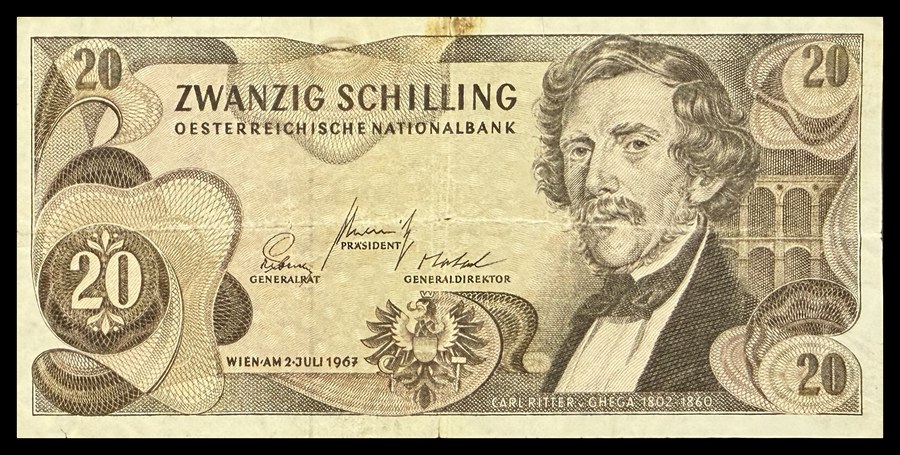
Front: Carl Ritter von Ghega (1802–1860), Austrian engineer of Albanian-Venetian descent who designed and built the Semmering Railway, the world's first true mountain railway and a pioneering engineering achievement. He is honoured on this note alongside imagery of his masterwork. The inscription reads 'CARL RITTER V. GHEGA 1802-1860'. The date 'WIEN AM 2. JULI 1967' indicates this note was issued in Vienna on July 2, 1967.
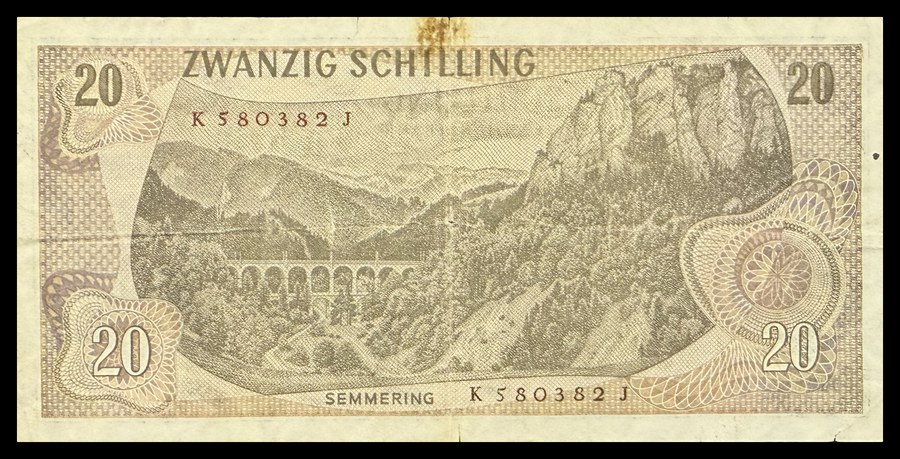
Back: The Semmering Railway crossing the Alps, specifically showing the Kalte Rinne Viaduct, one of the many spectacular engineering structures on the 41-kilometre railway line between Gloggnitz and Mürzzuschlag. Completed in 1854, the Semmering Railway was the first mountain railway in Europe built with a standard gauge track and featured 16 viaducts, 15 tunnels, and over 100 stone bridges. It was designated a UNESCO World Heritage Site in 1998 for its innovative engineering and integration with the mountainous landscape. The inscription 'SEMMERING' identifies the location.
How it was made
Signatures: Präsident: (illegible); Generalrat: (illegible); Generaldirektor: (illegible)
Security features: intaglio,microprint
Austria in Europe
Austria in Europe. Other countries on the same continent shown in muted grey.
Background & history
This note belongs to the Second Schilling series issued by the Oesterreichische Nationalbank from 1956 to 1983, following the reintroduction of the Austrian Schilling in 1945 after World War II. The series featured notable Austrian cultural and scientific figures. The 20 Schilling note honouring Carl von Ghega was issued from 1967 to 1983. The Austrian Schilling was replaced by the Euro on January 1, 1999 (for accounting purposes) and February 28, 2002 (for cash), when Schilling banknotes and coins were demonetized.
Collector references
How it came to me
Note shows moderate circulation with visible fold marks, some staining and discoloration at center, and general wear consistent with Fine grade.
What it's worth now
Valuation history (1)
| date | low | high | currency | source | note |
|---|---|---|---|---|---|
| 2026-05-08 08:12:55 | 2.0 | 4.0 | USD | ai | claude-sonnet-4-5: The 1967 P-142 20 Schilling is a common issue from the second series; F grade specimens typically retail for $2-4 based on recent dealer inventories. |
History & extractions
AI extractions (3)
Edits & decisions (0)
No edits yet.
Manual fixups
Find near-duplicates
Manual pairing override
Edit specimen #28
All fields below post to the same save endpoint. Sections collapse to focus on what you need.
Re-crop manually
Drag the four corners to mark the banknote in each image. Click Save crop to apply.