Collection › Burma (Myanmar) › #402
10 Rupee
P-M5
Needs review
✦ AI 88%
The AI flagged these for your attention. Use ✦ Fact-check to cross-check factual fields against another model's world-knowledge, or 🔍 Re-look at image when you suspect the AI misread the pixels.
-
Front and back images may not belong to the same note.Use 'Swap back with previous/next specimen' below — usually fixes a two-pair shuffle from photographing them out of order.
-
Some fields the AI was unsure about — please verify:
- Printer: “—” (30%)
- Issue year: “—” (50%)
Click ✦ Ask AI to verify or fix any below. -
Overall AI confidence is 88% (auto-approve threshold is 92%).Skim the Identity tab; the dots next to each field show what the AI was unsure about.
IMG_6993.HEIC
cropped
IMG_6994.HEIC
cropped
Where & when
What's on the note
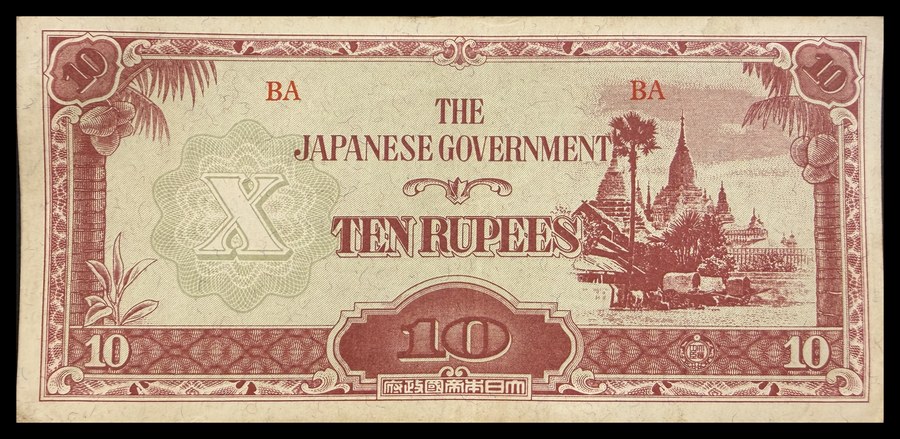
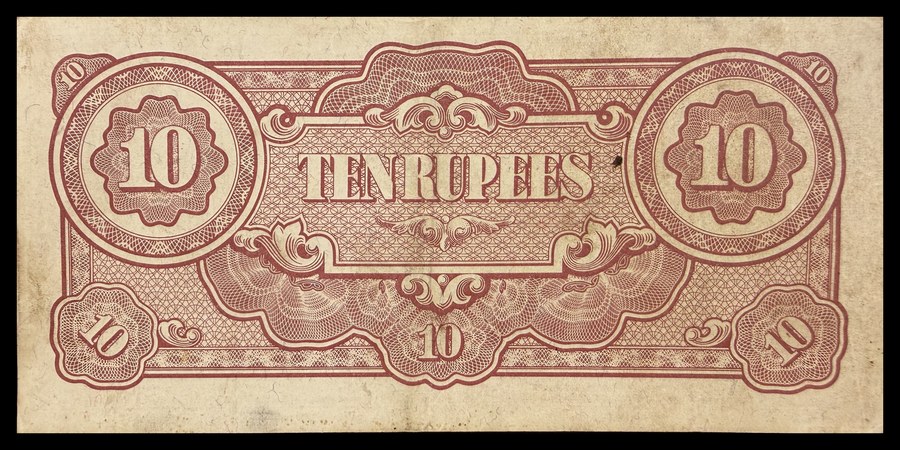
Front: Japanese Invasion Money 10 Rupees note. This note is part of the currency issued by the Japanese military administration during the occupation of Burma (1942–1945) in World War II. The front features elaborate guilloche patterns in green ink with the denomination '100' prominently displayed, though this appears to be the reverse of a 10 Rupees note based on the back inscription. These notes were mass-produced and circulated alongside or replaced existing currencies in occupied territories as part of Japan's Greater East Asia Co-Prosperity Sphere economic policy.
Back: The Shwedagon Pagoda in Rangoon (Yangon), Myanmar's most sacred Buddhist pagoda. Built over 2,500 years ago, the 326-foot gilded stupa dominates the Yangon skyline and is one of the most recognizable landmarks in Southeast Asia. The pagoda is depicted with surrounding palm trees and tropical vegetation, rendered in brown-red ink. The inscription 'THE JAPANESE GOVERNMENT' and 'TEN RUPEES' appears in English, with block letters 'BA' (likely a block or series indicator) in the upper corners. At bottom center, text in Burmese script appears alongside the denomination '10'.
How it was made
Where in the world
Geography unknown for Burma (Myanmar).
Background & history
Japanese Invasion Money (JIM) was military scrip issued by the Imperial Japanese government for use in occupied territories during World War II. In Burma, the Japanese occupation lasted from 1942 to 1945. These notes were printed in vast quantities with minimal security features and poor-quality paper, leading to rapid inflation and economic disruption. The Burma series featured local landmarks like the Shwedagon Pagoda to gain acceptance among the population. After Japan's defeat in 1945, all invasion money was declared worthless. This denomination is catalogued as Pick M5 in the Standard Catalog of World Paper Money (Military Issues). The series is well-documented and specimens are relatively common in the collectors' market today. No serial-year encoding is known for Japanese Invasion Money; dating relies on the documented occupation period of 1942–1945.
Collector references
How it came to me
Note shows signs of circulation with light soiling, some edge wear, and minor creasing. Paper remains intact with no tears.
What it's worth now
Valuation history (1)
| date | low | high | currency | source | note |
|---|---|---|---|---|---|
| 2026-05-10 06:44:20 | 5.0 | 15.0 | USD | ai | from claude-sonnet-4-5 |
History & extractions
AI extractions (2)
Edits & decisions (0)
No edits yet.
Manual fixups
Find near-duplicates
Manual pairing override
Edit specimen #402
All fields below post to the same save endpoint. Sections collapse to focus on what you need.
Re-crop manually
Drag the four corners to mark the banknote in each image. Click Save crop to apply.