Collection › Burma › #404
5 Rupees Burmese rupee
P-M4
Needs review
✦ AI 87%
The AI flagged these for your attention. Use ✦ Fact-check to cross-check factual fields against another model's world-knowledge, or 🔍 Re-look at image when you suspect the AI misread the pixels.
-
AI couldn't confidently identify the portrait or scene.Try Re-extract with a stronger model, or Ask AI to verify.
-
Some fields the AI was unsure about — please verify:
- Printer: “—” (0%)
- Dimensions (mm): “—” (0%)
- Front portrait: “—” (0%)
- Issue year: “—” (50%)
- Watermark: “—” (50%)
Click ✦ Ask AI to verify or fix any below. -
Overall AI confidence is 87% (auto-approve threshold is 92%).Skim the Identity tab; the dots next to each field show what the AI was unsure about.
IMG_6997.HEIC
cropped
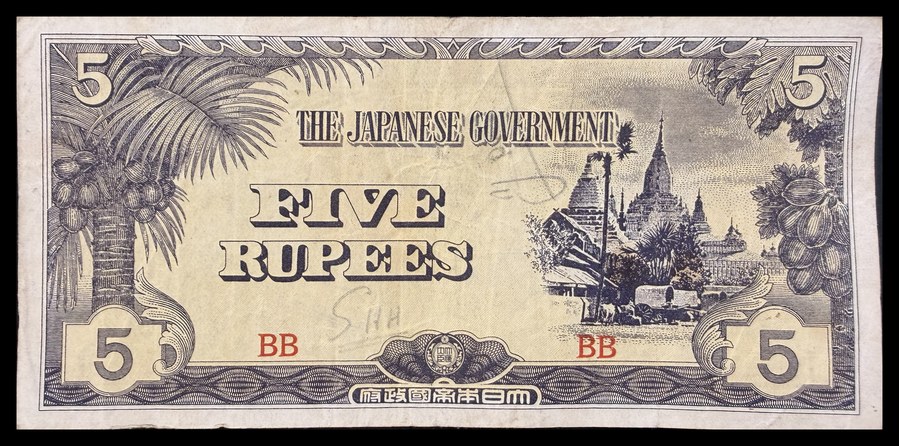
IMG_6998.HEIC
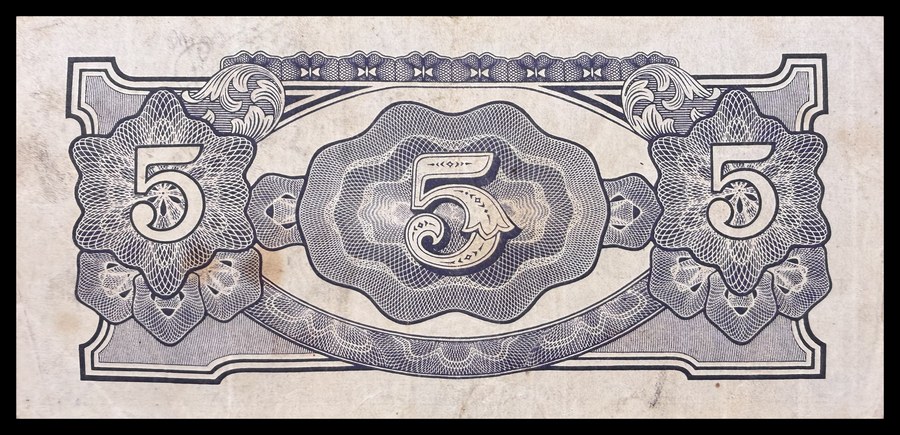
cropped
Where & when
What's on the note
Front: Ornate guilloche patterns forming decorative panels with the denomination ½ displayed prominently in mirror image on both sides. This is the obverse of a Japanese occupation note issued during World War II when Imperial Japanese forces occupied Burma (1942–1945). The minimalist design reflects emergency wartime printing conditions.
Back: Borobudur, the 9th-century Mahayana Buddhist temple complex in Central Java, Indonesia — one of the world's largest Buddhist monuments. The depiction shows the distinctive stupas and multi-tiered structure of this UNESCO World Heritage site. Japanese occupation currency frequently featured Buddhist and Hindu temples from Southeast Asia to promote pan-Asian solidarity under Japanese rule. Text reads 'THE JAPANESE GOVERNMENT' with denomination 'FIVE RUPEES' and block letters 'BB' in red. Japanese characters appear at the bottom.
How it was made
Security features: guilloche_patterns
Burma in Asia
Burma in Asia. Other countries on the same continent shown in muted grey.
Background & history
Japanese Invasion Money (JIM) issued for Burma during World War II occupation (1942–1945). Following Japan's conquest of Burma in 1942, the Imperial Japanese government issued military scrip denominated in rupees to replace the Indian rupee that had circulated under British rule. These notes, printed in large quantities, contributed to hyperinflation in occupied territories. The 'BB' block letters likely indicate a series or print run identifier. The use of Borobudur (located in Java, not Burma) reflects Japanese propaganda emphasizing Buddhist heritage across the Greater East Asia Co-Prosperity Sphere. These notes were demonetized immediately upon Japanese surrender in 1945 and hold primarily historical and collectible interest today. Pick catalog references for Japanese occupation notes use the 'M' prefix (Military).
Collector references
How it came to me
Note shows moderate circulation with soiling, creasing, and edge wear consistent with wartime usage. Paper remains intact with no tears visible.
What it's worth now
Valuation history (1)
| date | low | high | currency | source | note |
|---|---|---|---|---|---|
| 2026-05-10 06:45:00 | 5.0 | 15.0 | USD | ai | from claude-sonnet-4-5 |
History & extractions
AI extractions (2)
Edits & decisions (0)
No edits yet.
Manual fixups
Find near-duplicates
Manual pairing override
Edit specimen #404
All fields below post to the same save endpoint. Sections collapse to focus on what you need.
Re-crop manually
Drag the four corners to mark the banknote in each image. Click Save crop to apply.