Collection › Nepal › #406
1 Nepalese Rupee
P-8
Needs review
✦ AI 88%
The AI flagged these for your attention. Use ✦ Fact-check to cross-check factual fields against another model's world-knowledge, or 🔍 Re-look at image when you suspect the AI misread the pixels.
-
Some fields the AI was unsure about — please verify:
- Series name: “—” (0%)
- Series year: “—” (0%)
- Issue year: “—” (0%)
- Printer: “—” (0%)
- Dimensions (mm): “—” (0%)
- Watermark: “—” (0%)
Click ✦ Ask AI to verify or fix any below. -
Overall AI confidence is 88% (auto-approve threshold is 92%).Skim the Identity tab; the dots next to each field show what the AI was unsure about.
IMG_7002.HEIC
cropped
IMG_7003.HEIC
cropped
Where & when
What's on the note
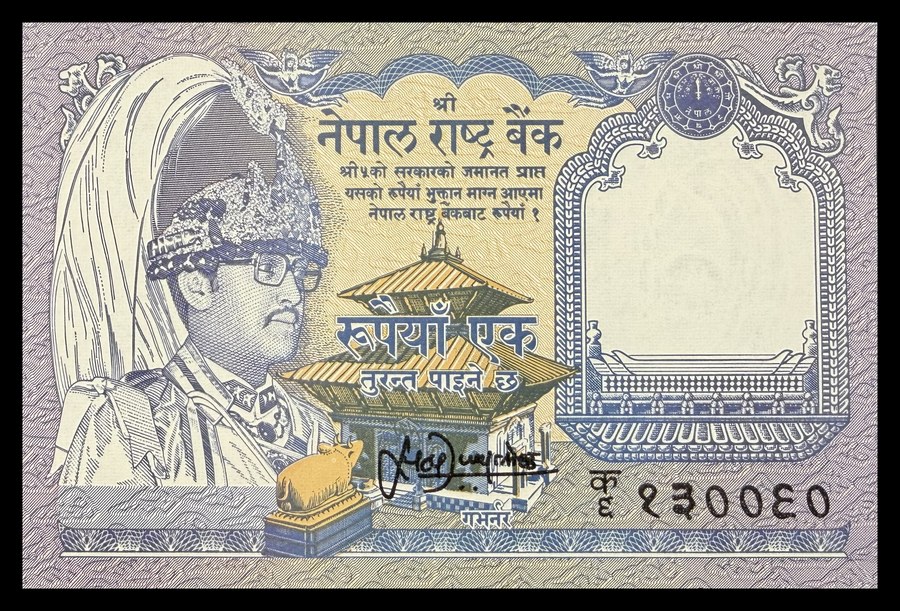
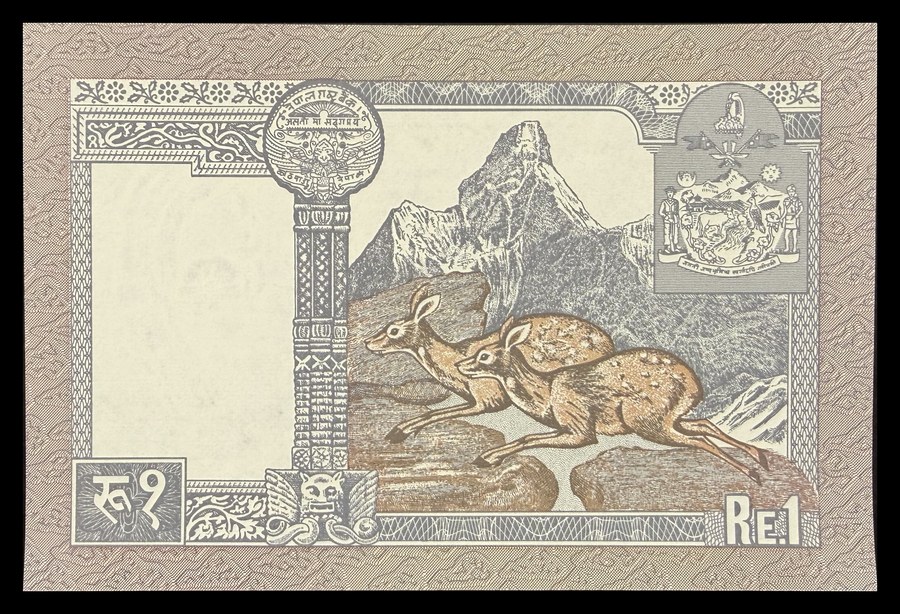
Front: One Rupee note of Nepal featuring geometric guilloche patterns and ornamental design typical of early Nepalese currency. The denomination '1' appears prominently at center within an ornate frame with scrollwork and traditional Nepali decorative elements in the corners.
Back: King Mahendra Bir Bikram Shah Dev (1920–1972), the ninth King of Nepal who ruled from 1955 to 1972, depicted in profile wearing glasses and traditional cap. He is remembered for introducing the Panchayat system of governance and modernizing Nepal's infrastructure. The note also features Singha Durbar, the grand neoclassical palace complex in Kathmandu that serves as the seat of the Government of Nepal, built in 1908 by Rana Prime Minister Chandra Shumsher. The palace name appears in Devanagari script along with 'Nepal Rastra Bank' at top.
How it was made
Security features: guilloche,microprint
Nepal in Asia
Nepal in Asia. Other countries on the same continent shown in muted grey.
Background & history
This is a One Rupee note issued by Nepal Rastra Bank during King Mahendra's reign (1955–1972). The serial number '१२३००२०' is printed in Devanagari numerals. This series represents the early post-monarchy establishment period when Nepal was modernizing its currency system under the Nepal Rastra Bank, which was established in 1956. The note features traditional Nepali architectural and royal imagery. Based on the design style, portrait of King Mahendra, and the Devanagari serial numbering system, this note likely dates from the 1960s period. King Mahendra's image appeared on Nepalese currency throughout his reign until his death in 1972.
Collector references
How it came to me
Note shows circulation wear with visible aging, minor staining, and some creasing. Paper remains intact with clear design elements.
What it's worth now
Valuation history (1)
| date | low | high | currency | source | note |
|---|---|---|---|---|---|
| 2026-05-10 06:45:33 | 2.0 | 8.0 | USD | ai | from claude-sonnet-4-5 |
History & extractions
AI extractions (1)
Edits & decisions (0)
No edits yet.
Manual fixups
Find near-duplicates
Manual pairing override
Edit specimen #406
All fields below post to the same save endpoint. Sections collapse to focus on what you need.
Re-crop manually
Drag the four corners to mark the banknote in each image. Click Save crop to apply.