Collection › Peru › #453
50 Intis PEN
P-131
AI extracted
✦ AI 92%
The AI flagged these for your attention. Use ✦ Fact-check to cross-check factual fields against another model's world-knowledge, or 🔍 Re-look at image when you suspect the AI misread the pixels.
-
Some fields the AI was unsure about — please verify:
- Printer: “—” (0%)
- Dimensions (mm): “—” (0%)
Click ✦ Ask AI to verify or fix any below.
IMG_7100.HEIC
cropped
IMG_7101.HEIC
cropped
Where & when
What's on the note
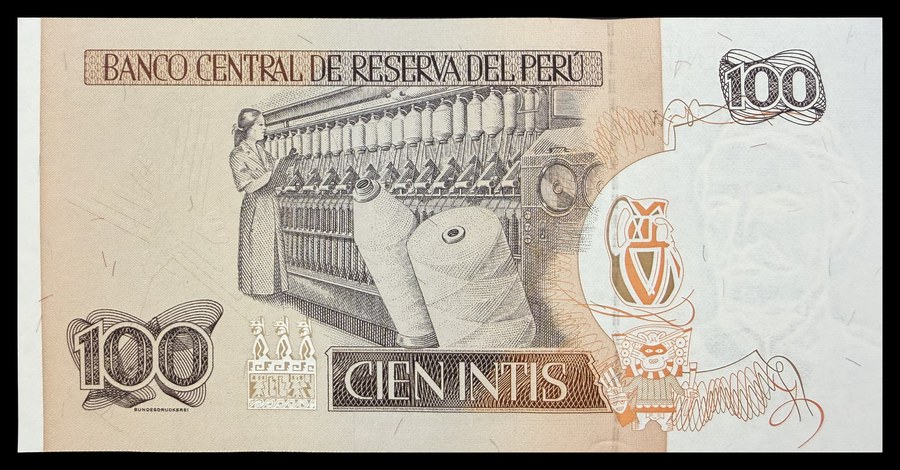
Front: Industrial oil extraction scene depicting Peru's petroleum industry with oil derrick, storage tanks, and workers. The imagery represents Peru's economic development and natural resource extraction during the 1980s, a period when the country sought to modernize its industrial infrastructure despite severe economic challenges including hyperinflation that led to the introduction of the Inti currency.
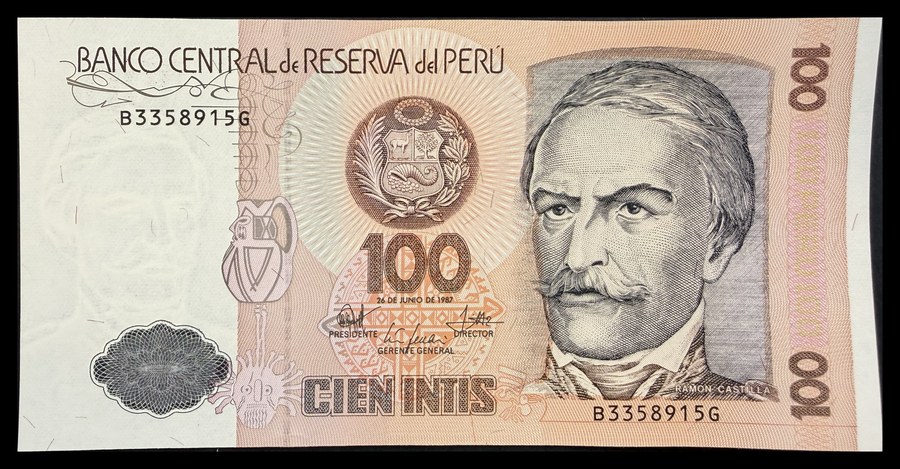
Back: Ramón Castilla y Marquesado (1797-1867), Peruvian military leader and president who served four terms between 1845 and 1867. He is honored on Peruvian currency for abolishing slavery in Peru (1854), modernizing the state, establishing the first railroad and telegraph systems, and promoting education and constitutional reform. The note features the coat of arms of Peru with its iconic vicuña, cinchona tree, and cornucopia symbolizing the nation's natural wealth. Date printed: 26 DE JUNIO DE 1987.
How it was made
Signatures: Presidente: signature visible; Director Gerente General: signature visible
Security features: microprint,intaglio,latent_image
Peru in South America
Peru in South America. Other countries on the same continent shown in muted grey.
Background & history
This note belongs to the Inti series (1985-1991), Peru's short-lived currency introduced to replace the Sol de Oro at a rate of 1,000 to 1 during a period of severe hyperinflation. The Inti itself suffered rapid devaluation and was replaced by the Nuevo Sol in 1991 at a rate of 1,000,000 to 1. The 50 Intis denomination was issued on June 26, 1987, as indicated by the printed date on the back. Ramón Castilla appears on multiple denominations of this series, reflecting his status as one of Peru's most respected 19th-century statesmen. The front depicts industrial development themes common to Latin American banknotes of the era, emphasizing national economic progress.
Collector references
How it came to me
Note appears uncirculated with sharp corners and no visible wear
What it's worth now
Valuation history (1)
| date | low | high | currency | source | note |
|---|---|---|---|---|---|
| 2026-05-10 06:57:06 | 1.0 | 3.0 | USD | ai | from claude-sonnet-4-5 |
History & extractions
AI extractions (1)
Edits & decisions (0)
No edits yet.
Manual fixups
Find near-duplicates
Manual pairing override
Edit specimen #453
All fields below post to the same save endpoint. Sections collapse to focus on what you need.
Re-crop manually
Drag the four corners to mark the banknote in each image. Click Save crop to apply.