Collection › Peru › #454
100 PEN
P-P-133
AI extracted
✦ AI 93%
The AI flagged these for your attention. Use ✦ Fact-check to cross-check factual fields against another model's world-knowledge, or 🔍 Re-look at image when you suspect the AI misread the pixels.
-
Some fields the AI was unsure about — please verify:
- Printer: “—” (0%)
Click ✦ Ask AI to verify or fix any below.
IMG_7102.HEIC
cropped
IMG_7103.HEIC
cropped
Where & when
What's on the note
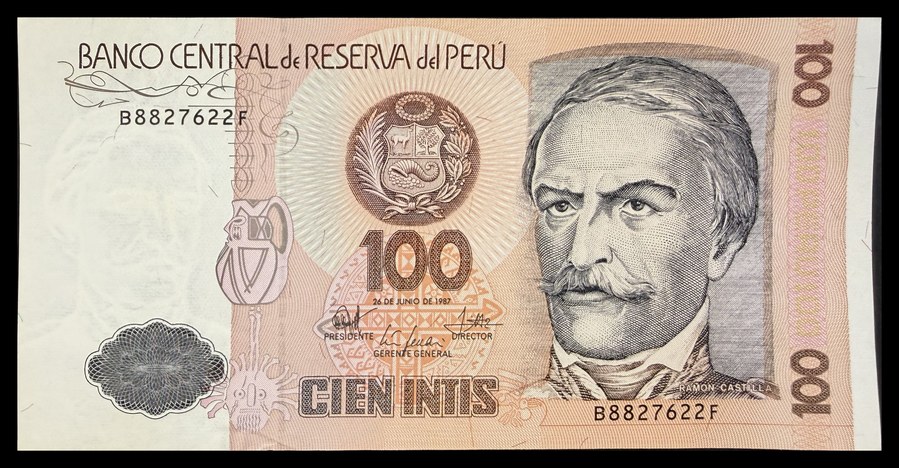
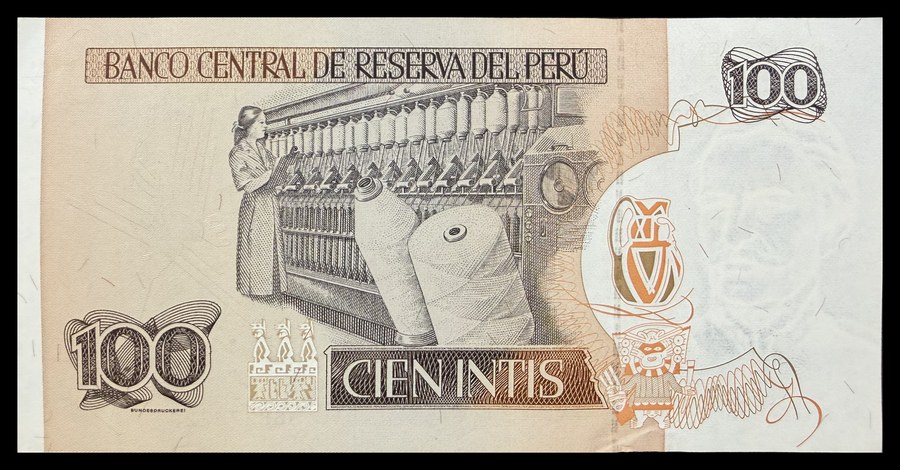
Front: Traditional Peruvian textile weaving scene depicting an indigenous woman operating a backstrap loom, representing Peru's rich textile heritage dating back to pre-Columbian civilizations. The horizontal loom shown was a fundamental technology in Andean cultures for producing textiles that were both utilitarian and ceremonial. The design emphasizes the continuity of indigenous craft traditions in modern Peru, with the weaver in traditional dress working at a loom characteristic of highland communities.
Back: Ramón Castilla y Marquesado (1797–1867), Peruvian military officer and statesman who served as President of Peru during multiple terms (1845–1851 and 1855–1862). He is celebrated for abolishing slavery in Peru in 1854, modernizing the state, stabilizing the economy through guano revenues, promoting railroad construction, and establishing the first telegraph lines. Castilla is regarded as one of Peru's greatest presidents and nation-builders of the 19th century. The coat of arms of Peru appears at center above the denomination.
How it was made
Signatures: Presidente: [illegible]; Director Gerente General: [illegible]
Security features: thread,microprint,intaglio
Peru in South America
Peru in South America. Other countries on the same continent shown in muted grey.
Background & history
This note belongs to the Inti series (1985–1991), introduced during Peru's severe hyperinflationary period under President Alan García's first administration. The Inti replaced the Sol at a rate of 1,000 to 1 in 1985 as the government attempted to stabilize the collapsing economy. The date '26 DE JUNIO DE 1987' is printed on the note. However, the Inti itself rapidly lost value through hyperinflation, which reached over 7,000% annually by 1990, and was replaced by the Nuevo Sol in 1991 at a rate of 1,000,000 Intis to 1 Nuevo Sol. The note pairs a 19th-century liberator figure with indigenous cultural imagery, reflecting Peru's dual heritage. The serial number format B8827622F follows the standard alpha-numeric-alpha pattern used by the Banco Central de Reserva del Perú during this period.
Collector references
How it came to me
Note shows moderate circulation with visible handling marks and minor soiling but retains good detail and no major damage
What it's worth now
Valuation history (1)
| date | low | high | currency | source | note |
|---|---|---|---|---|---|
| 2026-05-10 06:57:33 | 2.0 | 8.0 | USD | ai | from claude-sonnet-4-5 |
History & extractions
AI extractions (1)
Edits & decisions (0)
No edits yet.
Manual fixups
Find near-duplicates
Manual pairing override
Edit specimen #454
All fields below post to the same save endpoint. Sections collapse to focus on what you need.
Re-crop manually
Drag the four corners to mark the banknote in each image. Click Save crop to apply.