Collection › Russia › #508
250 Ruble
P-S1203
Needs review
✦ AI 88%
The AI flagged these for your attention. Use ✦ Fact-check to cross-check factual fields against another model's world-knowledge, or 🔍 Re-look at image when you suspect the AI misread the pixels.
-
Some fields the AI was unsure about — please verify:
- Printer: “—” (0%)
- Dimensions (mm): “—” (0%)
- Watermark: “—” (30%)
Click ✦ Ask AI to verify or fix any below. -
Overall AI confidence is 88% (auto-approve threshold is 92%).Skim the Identity tab; the dots next to each field show what the AI was unsure about.
IMG_7211.HEIC
cropped
IMG_7212.HEIC
cropped
Where & when
What's on the note
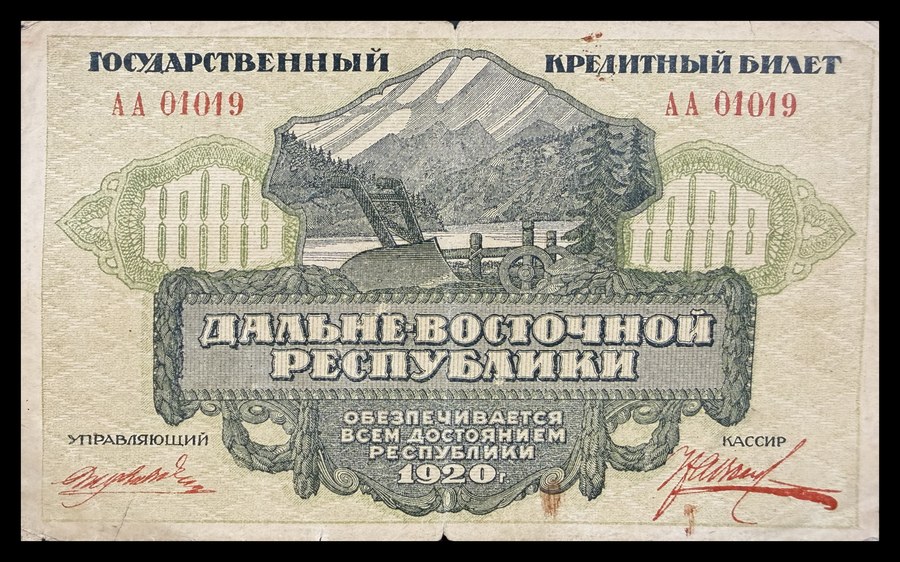
Front: State Credit Note of the Far Eastern Republic (Государственный Кредитный Билет Дальневосточной Республики), 250 rubles, dated 1917 but issued circa 1920. The Far Eastern Republic (1920-1922) was a nominally independent buffer state in eastern Siberia that existed between Soviet Russia and Japan-occupied territories during the Russian Civil War. This note represents the transitional currency issued by this short-lived republic before its reintegration into Soviet Russia. The denomination of 250 rubles reflects the hyperinflationary pressures of the Civil War period. Text indicates the note is secured by all property of the republic, backed with gold coins, and contains 17.424 shares of pure gold.
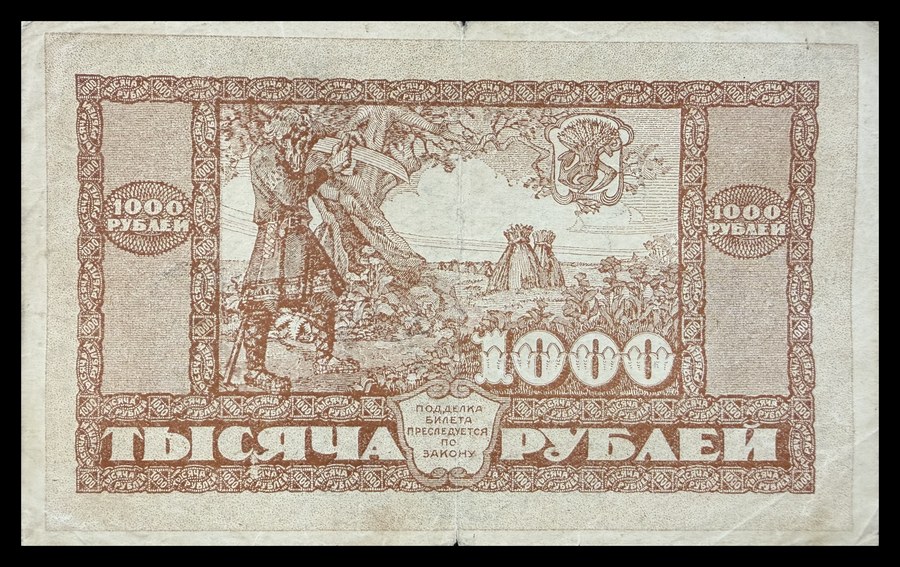
Back: Agricultural scene with a horse-drawn plow in the foreground and a prominent mountain in the background, likely representing the natural resources and agricultural economy of the Far Eastern territories. The text 'Дальневосточной Республики' (Far Eastern Republic) appears centrally, with the date 1920 below. The imagery emphasizes the agrarian foundation of the region and its natural landscape. Red signatures of the Manager (Upravlyayushchiy) and Cashier (Kassir) appear at bottom left and right.
How it was made
Signatures: Upravlyayushchiy (Manager): signature visible; Kassir (Cashier): signature visible
Security features: intaglio,microprint
Russia in Europe
Russia in Europe. Other countries on the same continent shown in muted grey.
Background & history
This 250 ruble note was issued by the Far Eastern Republic (Дальневосточная Республика), a buffer state that existed from April 1920 to November 1922 in eastern Siberia and the Russian Far East. Created under Soviet influence to avoid direct military confrontation with Japanese occupation forces, the republic had its capital in Chita (later Vladivostok). The note is dated 1917 on the front (likely referencing an earlier printing series or design authorization), but was actually issued circa 1920 during the republic's existence. Serial number AA 086 and AA 01019 (front and back respectively) suggest this is from an early print run. The Far Eastern Republic was dissolved and incorporated into the Russian Soviet Federative Socialist Republic in 1922 after Japanese withdrawal. These notes became demonetized upon reunification. The hyperinflationary context of the Russian Civil War necessitated high denominations like this 250 ruble note.
Collector references
How it came to me
Center fold visible, some edge wear and minor soiling, small tears at top edge, otherwise intact with clear printing and readable text
What it's worth now
Valuation history (1)
| date | low | high | currency | source | note |
|---|---|---|---|---|---|
| 2026-05-10 07:11:17 | 50.0 | 150.0 | USD | ai | from claude-sonnet-4-5 |
History & extractions
AI extractions (1)
Edits & decisions (0)
No edits yet.
Manual fixups
Find near-duplicates
Manual pairing override
Edit specimen #508
All fields below post to the same save endpoint. Sections collapse to focus on what you need.
Re-crop manually
Drag the four corners to mark the banknote in each image. Click Save crop to apply.