Collection › Russia › #509
1000 Ruble
P-P-13b
Needs review
✦ AI 88%
The AI flagged these for your attention. Use ✦ Fact-check to cross-check factual fields against another model's world-knowledge, or 🔍 Re-look at image when you suspect the AI misread the pixels.
-
Some fields the AI was unsure about — please verify:
- Dimensions (mm): “—” (0%)
- Watermark: “—” (50%)
Click ✦ Ask AI to verify or fix any below. -
Overall AI confidence is 88% (auto-approve threshold is 92%).Skim the Identity tab; the dots next to each field show what the AI was unsure about.
IMG_7213.HEIC
cropped
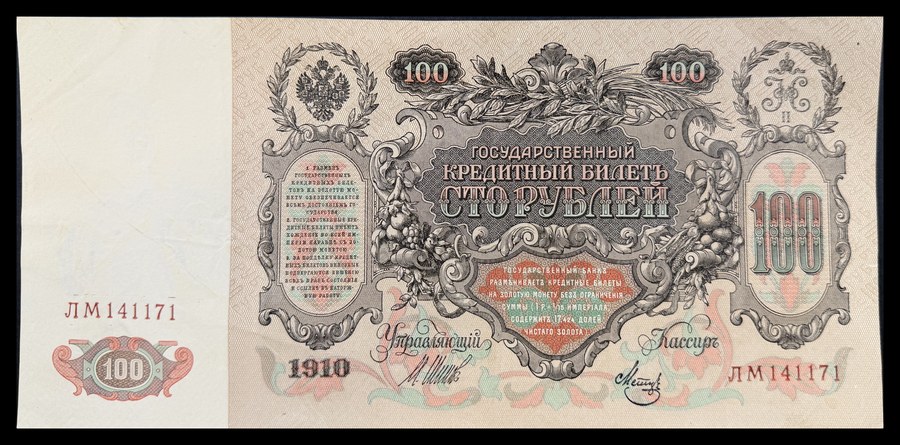
IMG_7214.HEIC
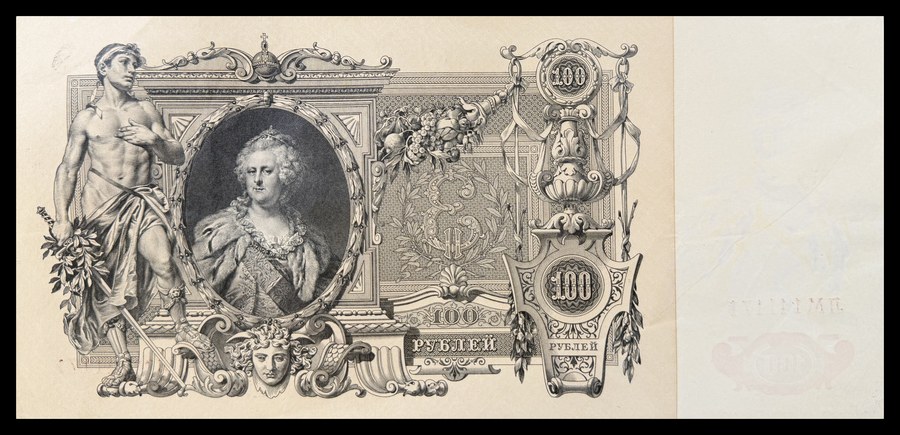
cropped
Where & when
What's on the note
Front: Allegorical scene depicting agricultural labor in rural Russia, showing peasant figures working in the countryside with trees and landscape elements. This design represents the agrarian foundation of the early Soviet economy during the Russian Civil War period. The denomination '1000 РУБЛЕЙ' (1000 rubles) appears prominently, with the warning text 'ПОДДЕЛКА БИЛЕТА ПРЕСЛЕДУЕТСЯ ПО ЗАКОНУ' (Counterfeiting of notes is prosecuted according to law) at bottom center.
Back: The Imperial Russian double-headed eagle within a laurel wreath appears at left, representing continuity with pre-revolutionary Russian state symbols despite the political transformation. The ornate center features the text 'ГОСУДАРСТВЕННЫЙ КРЕДИТНЫЙ БИЛЕТЪ СТО РУБЛЕЙ' (State Credit Note One Hundred Rubles) surrounded by elaborate baroque scrollwork and floral motifs. The date '1910' appears at bottom, indicating the design's origins in pre-revolutionary printing plates that were overprinted or reused during the Civil War shortage of paper and printing capacity. Serial number 'ЛМ141171' visible.
How it was made
Signatures: Cashier: signature visible; Manager: signature visible
Security features: intaglio,microprint
Russia in Europe
Russia in Europe. Other countries on the same continent shown in muted grey.
Background & history
This 1000-ruble note belongs to the State Credit Note series issued by the RSFSR during 1919–1920, a period of hyperinflation and economic chaos during the Russian Civil War. The back design reuses Imperial Russian printing plates from 1910, a common expedient when the Bolshevik government faced severe shortages of paper, ink, and printing capacity. The retention of the Imperial double-headed eagle on notes issued by the Soviet government reflects the pragmatic reuse of existing plates rather than ideological choice. This series was demonetized during the 1922–1924 currency reforms that introduced the chervonets and stabilized the Soviet monetary system. The serial prefix 'ЛМ' indicates a specific print run. No known public serial-year encoding exists for this issuer during this chaotic period.
Collector references
How it came to me
Note shows circulation wear with visible fold lines and minor edge wear; colors remain reasonably strong; no major tears evident
What it's worth now
Valuation history (1)
| date | low | high | currency | source | note |
|---|---|---|---|---|---|
| 2026-05-10 07:11:44 | 15.0 | 40.0 | USD | ai | from claude-sonnet-4-5 |
History & extractions
AI extractions (1)
Edits & decisions (0)
No edits yet.
Manual fixups
Find near-duplicates
Manual pairing override
Edit specimen #509
All fields below post to the same save endpoint. Sections collapse to focus on what you need.
Re-crop manually
Drag the four corners to mark the banknote in each image. Click Save crop to apply.