Collection › Burundi › #52
20 BIF
P-P-27b
AI extracted
✦ AI 92%
The AI flagged these for your attention. Use ✦ Fact-check to cross-check factual fields against another model's world-knowledge, or 🔍 Re-look at image when you suspect the AI misread the pixels.
-
Some fields the AI was unsure about — please verify:
- Series year: “—” (0%)
- Printer: “—” (0%)
Click ✦ Ask AI to verify or fix any below.
IMG_6153.jpeg
cropped
IMG_6154.jpeg
cropped
Where & when
What's on the note
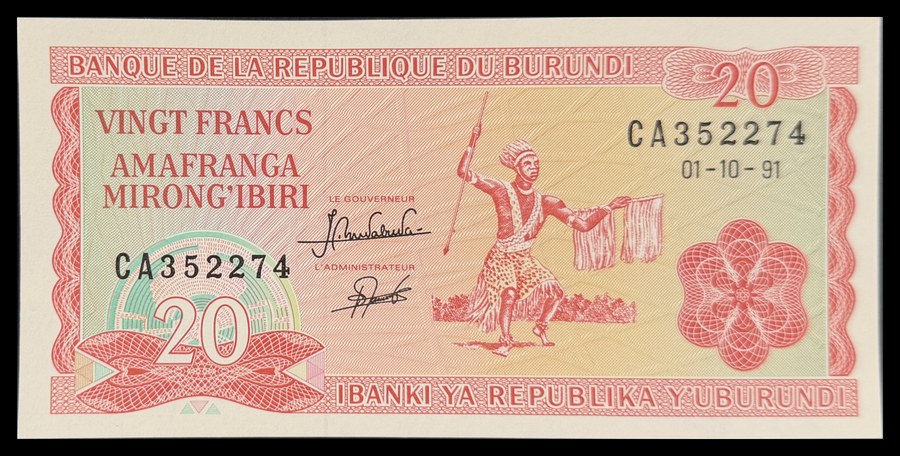
Front: Traditional Burundian drummer in ceremonial dress, performing with a royal drum (karyenda). The drummer represents Burundi's rich cultural heritage where royal drums were sacred symbols of kingship and used in coronation ceremonies and important state occasions. The traditional attire and the ceremonial performance reflect the deep significance of drumming in Burundian culture, which has been recognized by UNESCO as intangible cultural heritage.
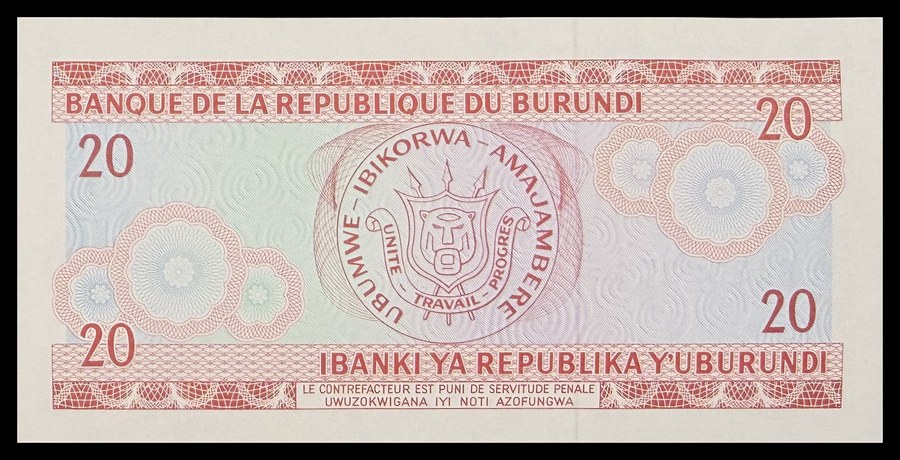
Back: National coat of arms of Burundi featuring a shield with the head of a lion, three spears behind it, and the national motto 'UNITE - TRAVAIL - PROGRES' (Unity, Work, Progress) on a ribbon below. The motto appears in French ('UNITE TRAVAIL PROGRES') with 'IBIKORWA AMAJAMBERE' visible in Kirundi, representing the nation's commitment to these founding principles. The coat of arms symbolizes sovereignty and national identity.
How it was made
Signatures: Le Gouverneur: (signature); L'Administrateur: (signature)
Security features: microprint,intaglio
Burundi in Africa
Burundi in Africa. Other countries on the same continent shown in muted grey.
Background & history
This note is from the 1991 issue series of the Burundian franc, printed during a transitional period in Burundi's history. The date 01-10-91 indicates October 1, 1991. This series continued to be issued through the 1990s and was eventually replaced by newer designs in the 2000s. The bilingual inscriptions in French and Kirundi reflect Burundi's official language policy. The traditional drummer motif was chosen to honor Burundi's cultural heritage, particularly the sacred royal drums (ingoma) that were central to the monarchy before it was abolished in 1966.
Collector references
How it came to me
Appears uncirculated with sharp corners and no visible wear
What it's worth now
Valuation history (1)
| date | low | high | currency | source | note |
|---|---|---|---|---|---|
| 2026-05-08 16:15:25 | 2.0 | 5.0 | USD | ai | from claude-sonnet-4-5 |
History & extractions
AI extractions (1)
Edits & decisions (0)
No edits yet.
Manual fixups
Find near-duplicates
Manual pairing override
Edit specimen #52
All fields below post to the same save endpoint. Sections collapse to focus on what you need.
Re-crop manually
Drag the four corners to mark the banknote in each image. Click Save crop to apply.