Collection › Slovenia › #529
20 SIT
P-12a
Needs review
✦ AI 88%
The AI flagged these for your attention. Use ✦ Fact-check to cross-check factual fields against another model's world-knowledge, or 🔍 Re-look at image when you suspect the AI misread the pixels.
-
Some fields the AI was unsure about — please verify:
- Series year: “—” (0%)
- Issue year: “—” (0%)
- Printer: “—” (0%)
- Watermark: “—” (0%)
Click ✦ Ask AI to verify or fix any below. -
Overall AI confidence is 88% (auto-approve threshold is 92%).Skim the Identity tab; the dots next to each field show what the AI was unsure about.
IMG_7255.HEIC
cropped
IMG_7256.HEIC
cropped
Where & when
What's on the note
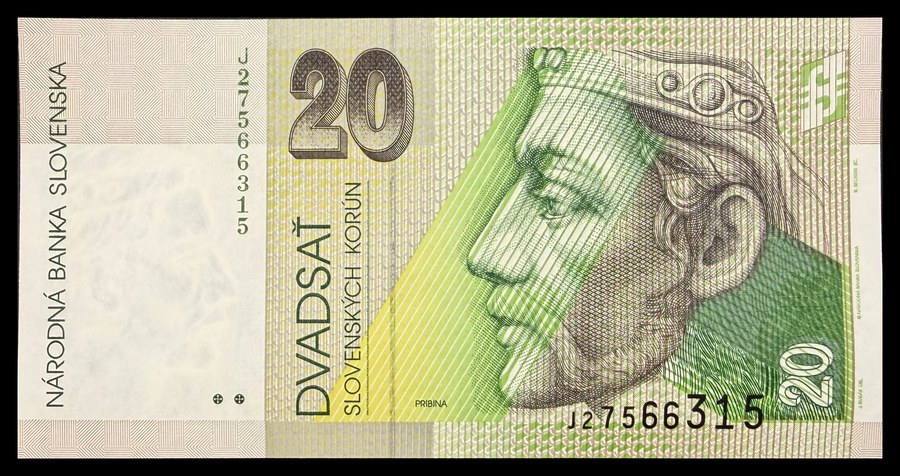
Front: Abstract mountain landscape design representing the Slovenian Alps. The front features stylized mountain peaks rendered in guilloche patterns typical of security printing, with the inscription 'REPUBLIKA SLOVENIJA' (Republic of Slovenia) at top and 'ENA' (one) at lower right, though the note is denominated as 20 tolarjev. The design emphasizes Slovenia's Alpine geography and natural heritage through abstract geometric representation.
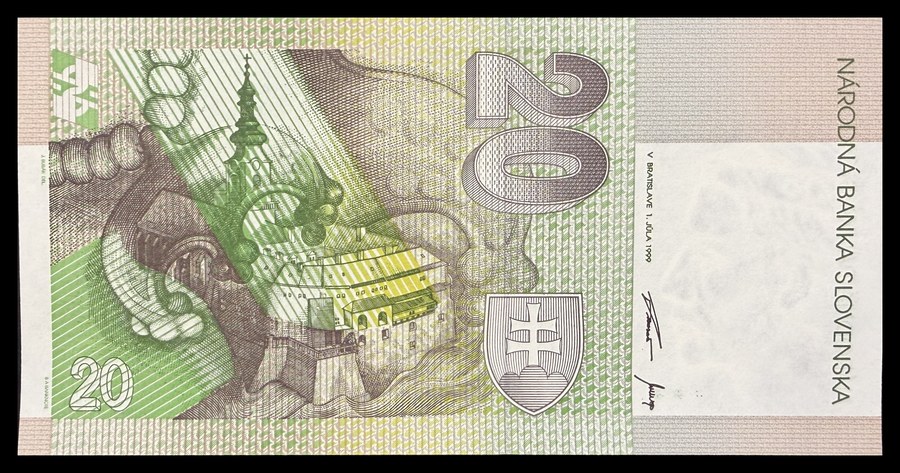
Back: Lipizzaner horses (Lipica stud farm horses), Slovenia's most famous equine breed originating from the Lipica stud farm established in 1580 during Habsburg rule. Two horses are depicted in fine engraved detail with the text 'DVAJSET SLOVENSKIH KORUN' (Twenty Slovenian Crowns) visible. The Lipizzaner is celebrated as a symbol of Slovenian cultural heritage and represents the nation's centuries-long tradition of horse breeding at the Lipica stud farm, now located in southwestern Slovenia near the Italian border.
How it was made
Security features: microprint,intaglio,see_through_register
Slovenia in Europe
Slovenia in Europe. Other countries on the same continent shown in muted grey.
Background & history
The Slovenian tolar (SIT) was introduced on 8 October 1991 following Slovenia's declaration of independence from Yugoslavia in June 1991, replacing the Yugoslav dinar at par. The tolar served as Slovenia's national currency from 1991 until 1 January 2007, when Slovenia became the first former Yugoslav republic to adopt the euro. The 20 tolar note was part of the original series issued by the newly established Bank of Slovenia (Narodna Banka Slovenije / Banka Slovenije). The series featured designs emphasizing Slovenian natural landscapes, cultural heritage, and national symbols as the new nation asserted its independent identity. This note's design combines abstract Alpine mountain imagery on the front with the iconic Lipizzaner horses on the reverse, linking Slovenia's geographic identity with its equestrian heritage. The Lipica stud farm, established in 1580 by Archduke Charles II of Austria, has been breeding the famous white Lipizzaner horses for over four centuries and is one of Slovenia's most important cultural sites. All tolar banknotes were demonetized when Slovenia joined the eurozone on 1 January 2007, though they could be exchanged at banks until 31 December 2016 at the fixed rate of 239.640 SIT = 1 EUR.
Collector references
How it came to me
What it's worth now
Valuation history (1)
| date | low | high | currency | source | note |
|---|---|---|---|---|---|
| 2026-05-10 07:16:44 | 2.0 | 5.0 | USD | ai | from claude-sonnet-4-5 |
History & extractions
AI extractions (1)
Edits & decisions (0)
No edits yet.
Manual fixups
Find near-duplicates
Manual pairing override
Edit specimen #529
All fields below post to the same save endpoint. Sections collapse to focus on what you need.
Re-crop manually
Drag the four corners to mark the banknote in each image. Click Save crop to apply.