Collection › Syria › #556
100 SYP
P-104
AI extracted
✦ AI 92%
The AI flagged these for your attention. Use ✦ Fact-check to cross-check factual fields against another model's world-knowledge, or 🔍 Re-look at image when you suspect the AI misread the pixels.
-
Some fields the AI was unsure about — please verify:
- Printer: “—” (0%)
- Front portrait: “—” (0%)
Click ✦ Ask AI to verify or fix any below.
IMG_7309.HEIC
cropped
IMG_7310.HEIC
cropped

Where & when
What's on the note
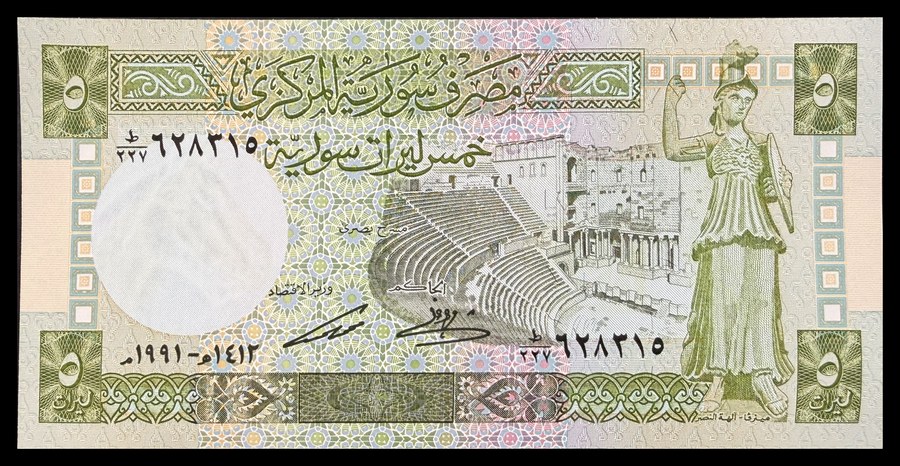
Front: The Bosra Roman Theatre, one of the best-preserved Roman theatres in the world, located in southern Syria and built in the 2nd century CE during the reign of Roman Emperor Trajan. The theatre could seat approximately 15,000 spectators and remains a UNESCO World Heritage site. Also depicted is a commemorative coin and traditional Syrian architectural elements including a minaret with Islamic geometric patterns.
Back: The Roman Theatre at Bosra shown from the stage perspective with its semicircular seating arrangement (cavea) and scaenae frons (stage building). At right is a statue from ancient Philippopolis (modern Shahba), depicting a classical draped figure, likely from the collection of the archaeological museum at Shahba. The city of Shahba was the birthplace of Roman Emperor Philip the Arab (Marcus Julius Philippus, ruled 244–249 CE) who commissioned significant building works there. The back features Arabic calligraphy and Islamic geometric patterns.
How it was made
Security features: microprint,intaglio,watermark,security_thread
Syria in Asia
Syria in Asia. Other countries on the same continent shown in muted grey.
Background & history
This note belongs to Syria's 1990 banknote series issued by the Central Bank of Syria (Banque Centrale de Syrie / مصرف سورية المركزي). The series prominently featured Syria's rich archaeological heritage, with this 100 Syrian Pound note showcasing the Roman Theatre at Bosra, one of the finest examples of Roman provincial architecture. The note includes the Hijri date 1413 (1991–1992 CE) and commemorates Syria's position as a crossroads of ancient civilizations. The watermark depicts Philip the Arab (Marcus Julius Philippus), the only Roman emperor of Arab origin, born in Shahba circa 204 CE. This series was gradually replaced by newer issues from the late 1990s onward, with most notes of this design withdrawn from circulation by the 2000s.
Collector references
How it came to me
Appears uncirculated with sharp corners and no visible folds
What it's worth now
Valuation history (1)
| date | low | high | currency | source | note |
|---|---|---|---|---|---|
| 2026-05-10 07:23:18 | 2.0 | 8.0 | USD | ai | from claude-sonnet-4-5 |
History & extractions
AI extractions (1)
Edits & decisions (0)
No edits yet.
Manual fixups
Find near-duplicates
Manual pairing override
Edit specimen #556
All fields below post to the same save endpoint. Sections collapse to focus on what you need.
Re-crop manually
Drag the four corners to mark the banknote in each image. Click Save crop to apply.