Collection › Uzbekistan › #606
200 UZS
P-79
AI extracted
✦ AI 92%
The AI flagged these for your attention. Use ✦ Fact-check to cross-check factual fields against another model's world-knowledge, or 🔍 Re-look at image when you suspect the AI misread the pixels.
-
Some fields the AI was unsure about — please verify:
- Printer: “—” (0%)
Click ✦ Ask AI to verify or fix any below.
IMG_7409.HEIC
cropped
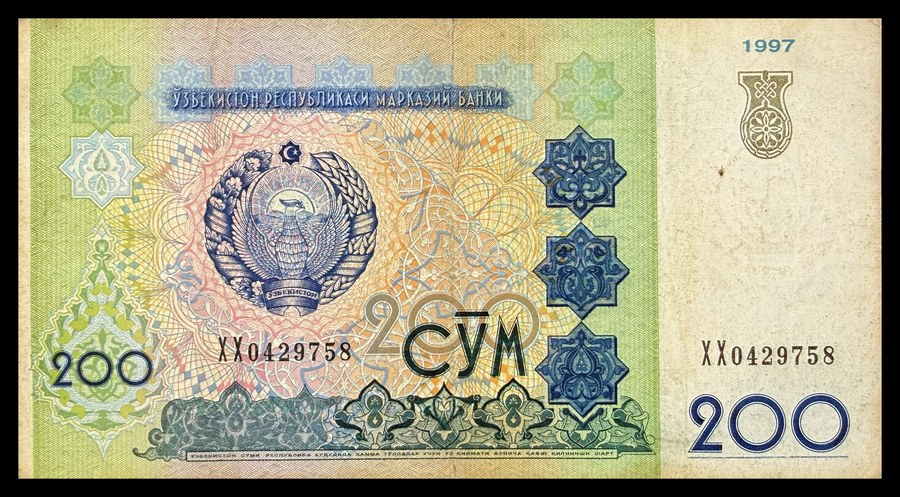
IMG_7410.HEIC
cropped
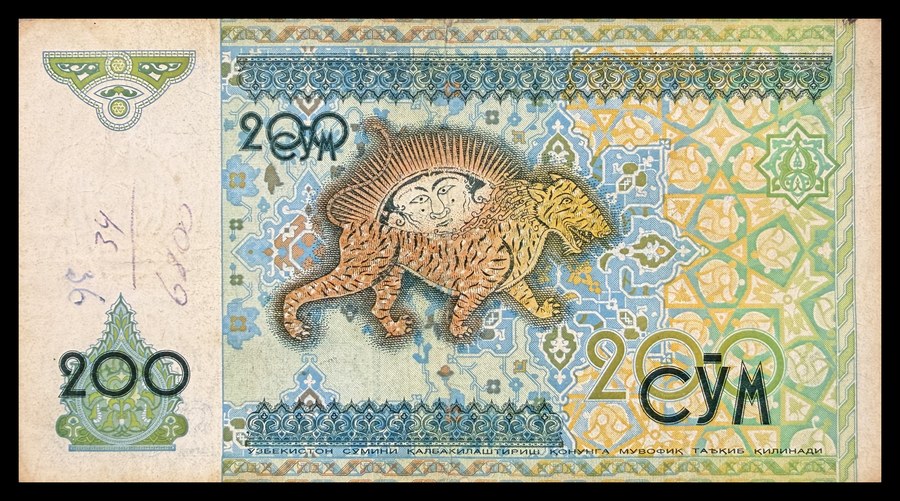
Where & when
What's on the note
Front: A mythological tiger (Bukhara tiger motif) rendered in traditional Uzbek decorative style against an ornamental background featuring Islamic geometric patterns and tilework designs. The tiger, a symbol deeply embedded in Central Asian mythology and art, appears in profile with stylized sun rays above its head. The denomination '200 СЎМ' (200 som) appears in both Latin and Cyrillic scripts. The inscription at bottom reads 'Ўзбекистон сўмини қалбакилаштириш қонунга мувофиқ таъқиб қилинади' (counterfeiting Uzbekistan som is prosecuted according to law).
Back: The State Emblem of Uzbekistan (1992–present) at center left, featuring the Humo bird (a phoenix-like mythical bird symbolizing happiness and freedom) with outstretched wings, rising sun over mountains, cotton and wheat, surrounded by a wreath. The emblem is overlaid on intricate geometric and floral patterns typical of Timurid-era Islamic art. The denomination appears prominently, with the printed year '1997' in the upper right corner. Serial number XX0429758 appears twice. The text at top reads 'ЎЗБЕКИСТОН РЕСПУБЛИКАСИ МАРКАЗИЙ БАНКИ' (Central Bank of the Republic of Uzbekistan).
How it was made
Security features: microprint,intaglio,latent_image
Uzbekistan in Asia
Uzbekistan in Asia. Other countries on the same continent shown in muted grey.
Background & history
This 200 som note belongs to the second series of Uzbekistan som banknotes issued in 1997 following independence from the Soviet Union in 1991. The som replaced the Soviet ruble in 1994, and this series represents the stabilization period after initial post-independence currency volatility. The design incorporates traditional Uzbek and Central Asian artistic motifs including geometric Islamic patterns inspired by the architectural heritage of Samarkand, Bukhara, and Khiva. The tiger imagery reflects the historical Bukhara tiger (Panthera tigris virgata), which was native to Central Asia until its extinction in the 1970s, and remains a powerful symbol in Uzbek cultural identity. This series was withdrawn in 2000 when a new redesigned series was introduced. The serial number prefix 'XX' may indicate a specific print run, though no documented replacement-note system is publicly known for this issuer.
Collector references
How it came to me
Note shows light handling and minor circulation wear but retains strong detail and original crispness.
What it's worth now
Valuation history (1)
| date | low | high | currency | source | note |
|---|---|---|---|---|---|
| 2026-05-10 07:34:55 | 5.0 | 15.0 | USD | ai | from claude-sonnet-4-5 |
History & extractions
AI extractions (1)
Edits & decisions (0)
No edits yet.
Manual fixups
Find near-duplicates
Manual pairing override
Edit specimen #606
All fields below post to the same save endpoint. Sections collapse to focus on what you need.
Re-crop manually
Drag the four corners to mark the banknote in each image. Click Save crop to apply.