Collection › Yugoslavia › #650
10000 Yugoslav Dinar
P-116
Needs review
✦ AI 90%
The AI flagged these for your attention. Use ✦ Fact-check to cross-check factual fields against another model's world-knowledge, or 🔍 Re-look at image when you suspect the AI misread the pixels.
-
Some fields the AI was unsure about — please verify:
- Watermark: “—” (40%)
- Issue year: “—” (50%)
Click ✦ Ask AI to verify or fix any below. -
Overall AI confidence is 90% (auto-approve threshold is 92%).Skim the Identity tab; the dots next to each field show what the AI was unsure about.
IMG_7497.HEIC
cropped
IMG_7498.HEIC
cropped
Where & when
What's on the note
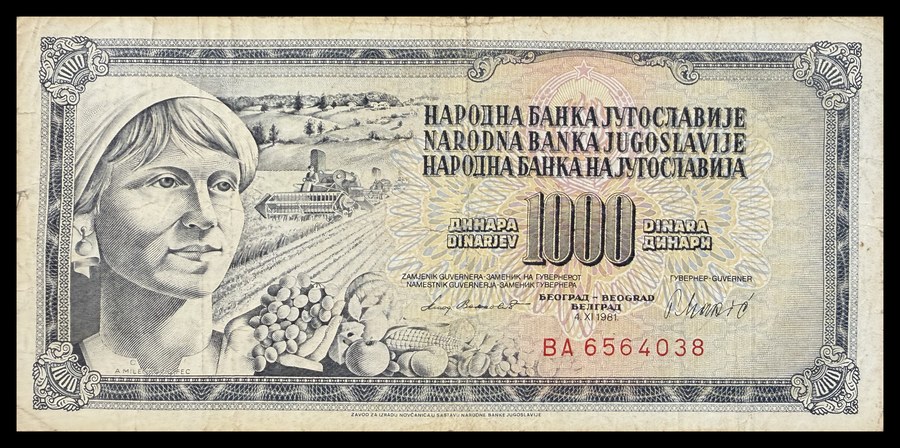
Front: Young woman in traditional Yugoslav folk costume, representing the youth and agriculture of the nation. The design reflects the socialist-era emphasis on rural life and collective farming during the final years of the Socialist Federal Republic of Yugoslavia. The note was issued during the severe hyperinflation crisis that preceded the breakup of Yugoslavia.
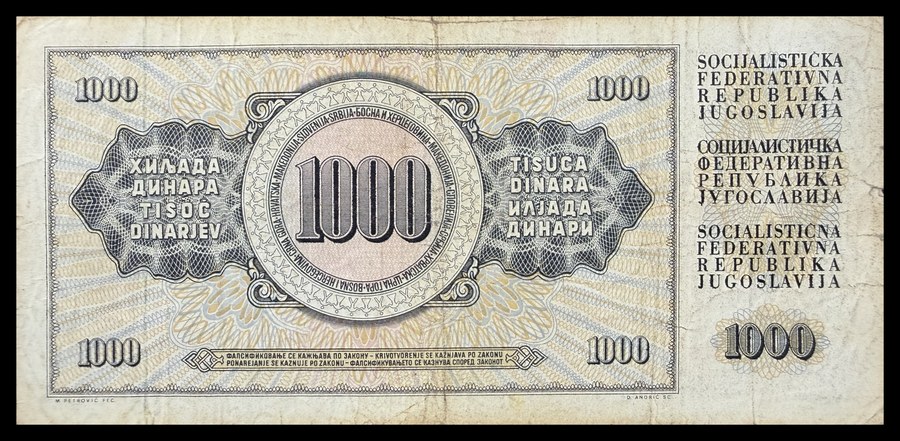
Back: Agricultural harvest scene featuring a combine harvester in wheat fields with workers gathering produce including corn, grapes, and other crops. This imagery symbolizes Yugoslavia's agricultural productivity and the importance of farming to the economy. The scene emphasizes the collective agricultural model promoted during the socialist period, though this note circulated during the country's economic collapse.
How it was made
Signatures: Governor: signature visible dated 1.XI 1981
Security features: microprint,intaglio
Where in the world
Geography unknown for Yugoslavia.
Background & history
This 10,000 dinar note belongs to the 1992 series issued by the National Bank of Yugoslavia during the catastrophic hyperinflation that accompanied the disintegration of the Socialist Federal Republic of Yugoslavia. The series was printed with a 1981 signature date but circulated from 1992 to 1993 as the dinar collapsed in value. Within months, denominations escalated into the millions and billions as Yugoslavia experienced one of the worst hyperinflations in history, second only to Hungary 1946. The note was demonetized on January 24, 1994, when the 1994 New Dinar replaced the old dinar at a rate of 1:1,000,000. This series is characterized by reused designs from earlier periods with updated denominations to meet the demands of rapidly escalating prices. Pick number P-116.
Collector references
How it came to me
Light soiling and circulation wear visible, particularly at edges and corners. Some minor staining on reverse.
What it's worth now
Valuation history (1)
| date | low | high | currency | source | note |
|---|---|---|---|---|---|
| 2026-05-10 07:45:57 | 1.0 | 5.0 | USD | ai | from claude-sonnet-4-5 |
History & extractions
AI extractions (1)
Edits & decisions (0)
No edits yet.
Manual fixups
Find near-duplicates
Manual pairing override
Edit specimen #650
All fields below post to the same save endpoint. Sections collapse to focus on what you need.
Re-crop manually
Drag the four corners to mark the banknote in each image. Click Save crop to apply.