Collection › Yugoslavia › #653
100 YUD
P-P-112
Needs review
✦ AI 55%
The AI flagged these for your attention. Use ✦ Fact-check to cross-check factual fields against another model's world-knowledge, or 🔍 Re-look at image when you suspect the AI misread the pixels.
-
Front and back images may not belong to the same note.Use 'Swap back with previous/next specimen' below — usually fixes a two-pair shuffle from photographing them out of order.
-
Overall AI confidence is 55% (auto-approve threshold is 92%).Skim the Identity tab; the dots next to each field show what the AI was unsure about.
-
Some fields the AI was unsure about — please verify:
- Serial number: “—” (0%)
- Reverse subject: “—” (30%)
- Watermark: “Geometric pattern with denomination” (60%)
Click ✦ Ask AI to verify or fix any below.
IMG_7503.HEIC
cropped
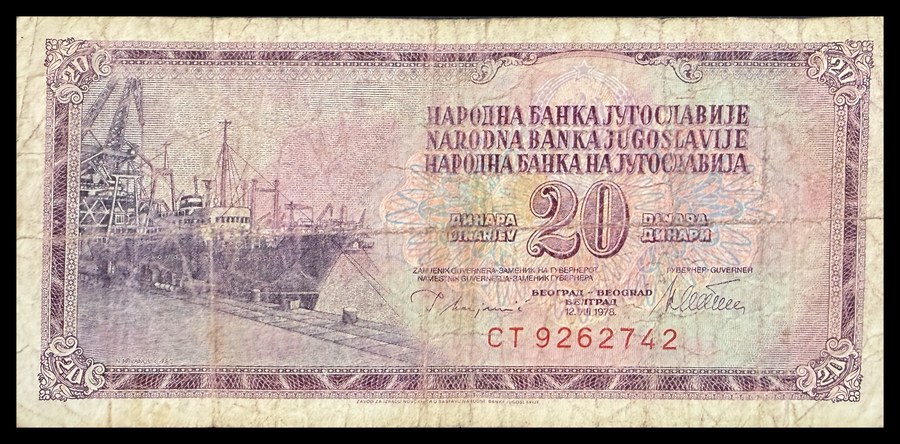
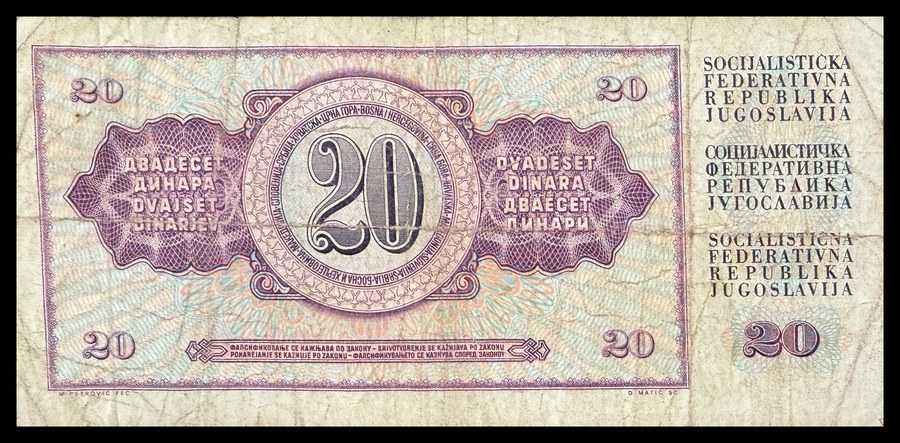
IMG_7504.HEIC
cropped
Where & when
What's on the note
Front: Abstract design featuring stylized wheat sheaves representing Yugoslav agriculture. The note displays the denomination '100' and text in both Cyrillic (ЈУГОСЛАВИЈА) and Latin (JUGOSLAVIJA) scripts, reflecting the multi-ethnic nature of the Federal Republic of Yugoslavia. The design is notably abstract compared to earlier Yugoslav issues, part of the emergency-style notes issued during the hyperinflationary period. Printed in Belgrade, 1992.
Back: This appears to be a mismatched image showing a 20 dinara note from the 1978 series featuring a Yugoslav port scene with cargo cranes and ships, representing industrial development. The note shows serial number CT 9262742 and is dated 12.VIII.1978. This is NOT the reverse of the 100 dinara 1992 note shown in the front image.
How it was made
Signatures: Governor: Dragoslav Avramović
Security features: microprint,intaglio
Where in the world
Geography unknown for Yugoslavia.
Background & history
The 100 dinara note from 1992 was issued by the Federal Republic of Yugoslavia (Serbia and Montenegro) during the early stages of hyperinflation that would devastate the country's economy. Following the breakup of Yugoslavia in 1991-1992, the rump state experienced severe economic crisis due to international sanctions and war costs. This series was quickly superseded as inflation accelerated, leading to the famous 500 billion dinar notes by 1993. The July 1992 reform (1 new dinar = 10 old dinars) was the first of several redenominations. The note was printed at the Yugoslav Institute for Manufacturing Banknotes and Coins in Belgrade (Zavod za izradu novčanica i kovanog novca).
Collector references
How it came to me
Significant circulation wear, multiple fold lines, some discoloration and staining visible. Paper shows handling marks throughout.
What it's worth now
Valuation history (1)
| date | low | high | currency | source | note |
|---|---|---|---|---|---|
| 2026-05-10 07:46:19 | 0.25 | 1.5 | USD | ai | from claude-opus-4-5 |
History & extractions
AI extractions (2)
Edits & decisions (0)
No edits yet.
Manual fixups
Find near-duplicates
Manual pairing override
Edit specimen #653
All fields below post to the same save endpoint. Sections collapse to focus on what you need.
Re-crop manually
Drag the four corners to mark the banknote in each image. Click Save crop to apply.